Curiosity: Great questions spark great conversations.

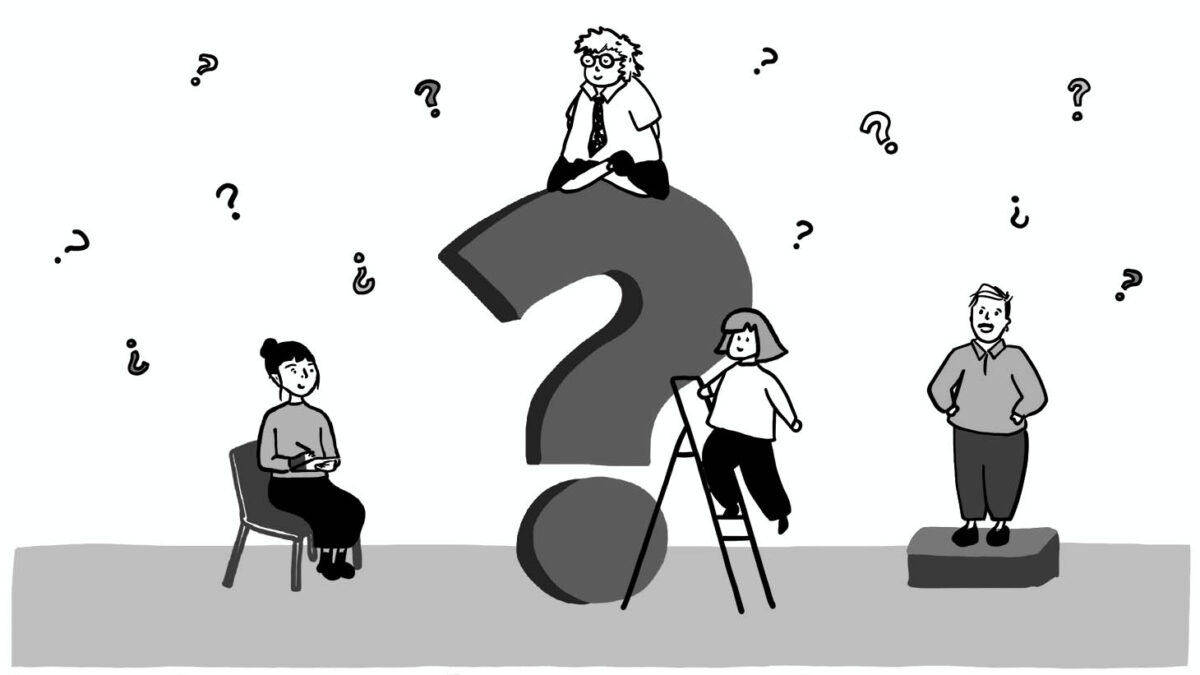
A big question mark with people around it

Have you ever noticed how kids cut right to the heart of things with their questions? They catch you off guard in their blunt innocence: “Do you still love him?” No question is out of bounds: “Why don’t you have any hair?” They make you think again about everything: “Why? Why!? WHY!?”

Somewhere along the path of getting older, we get more inhibited with our questions – if we even ask them at all. There is an idea that we should know better, and yet perhaps it is this thought that leads to problematic assumptions more than a baseline of open-mindedness ever did.

The quality of our conversations often depends on the quality of our questions. If we want deeper, more meaningful chats, we need to take a cue from the little ones and bring curiosity into the conversation.


So, what makes a good conversational question?

Part of the problem is that we’re trained to look for clear answers. This implies that there is a clear answer, but if we accept that everything is constantly changing then the reality is that what we’re looking at is a moment on a timeline of shifting understanding and story.

“What do you think about _____?” we ask, filling in the blank with the issue at hand.

It’s not a bad question, but it prompts a person to respond quickly with their conclusive thoughts in that moment. Useful, yes – but not in the same way that a kid’s question forces second thoughts in the answer one gives.

Instead, try asking, “How did you come to believe _____?”

This is the equivalent of a kid responding to the previous question’s answer with an open-ended, “Why???” – but without the awkwardness of an adult feeling juvenile by doing the same.

Framing the question in a wider timeline invites the other person to storify their answer. People are much more revealing and personal when they are telling stories. They talk about the people and experience that shaped their values – showing their humanness which in turn improves our human connection.

Three hands hold up question mark signs

Great questions spark great conversations, and this is true in the case of tough conversations as well. We might not always agree with another person’s perspective, but if we can keep having conversations we can at least begin to better understand each other.

When we find ourselves hitting a wall with someone – a friend, a family member, a colleague or neighbour – this usually means that judgment has established itself in the situation. This creates a perception of separateness, because we can’t understand why the other person is acting the way they are and don’t know what to say anymore.

It is in exactly these conflicts where getting curious about the other person’s perspective and asking the right questions can open up a path where otherwise it was an impasse.

How?

  1. Notice your frustration and agitation. Take a deep breath.
  2. Understand the defensive response that is within you, but slow it down so that you don’t just react.
  3. Ask a question that invites the other person to explain their perspective.

And then, keep the conversation with looping: listening as best you can, paraphrasing back what you’ve heard, and letting the other person clarify – repeating until there’s a shared understanding.

Active listening means being an active participant. You want to be listening so actively that you’re burning calories.


If we subscribe to the idea that great questions spark great conversations, why settle? Curiosity might just be the remedy you need the next time you find yourself at odds with someone.

Active Listening: The art of clarification.

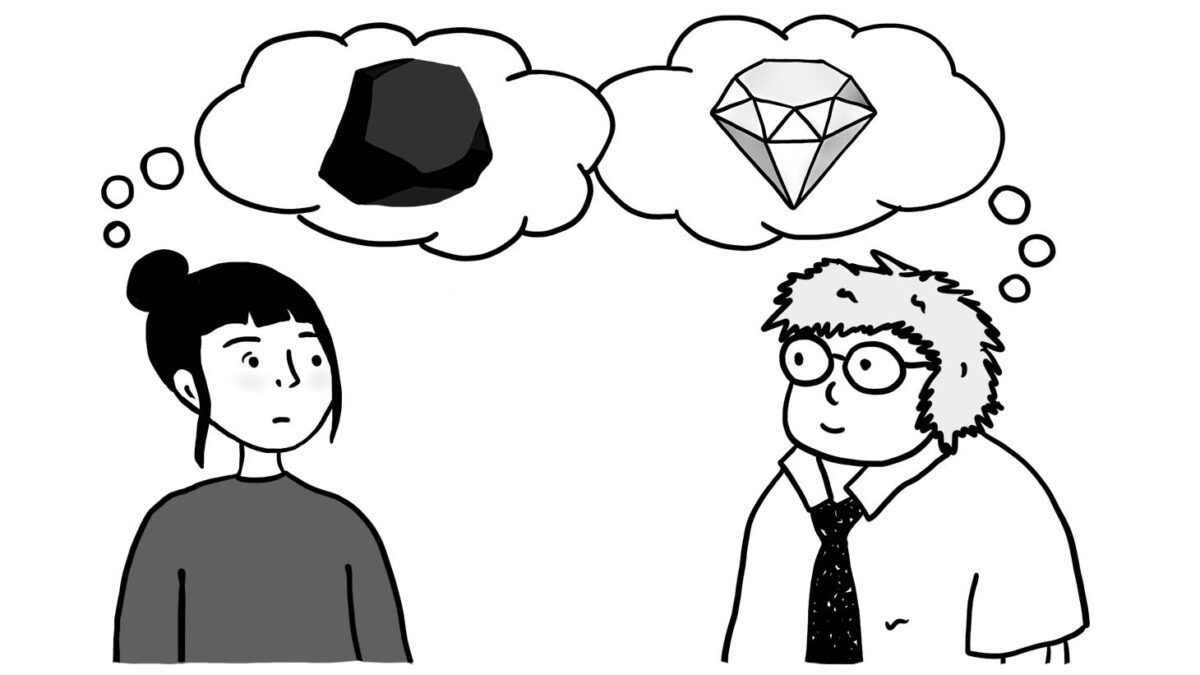
Two characters face each other in conversation with thought bubbles, one imagining coal and the other a diamond

“Is this real?”

Whether in a dream or just daydreaming at work, it’s a good question.

Consider your five senses: sight, hearing, smell, taste, and touch. These inputs are the only ways you receive information about the world. Then, the brain makes sense of all of this raw data and constructs its perceived reality – this is blue, that is cozy, they…are a threat.

Human biology has us constantly scanning for things that are unsafe. This negativity bias is one of a myriad of leaps in logic that can cause inaccurate perceptions of others.

And so, to this constructed reality in our heads, we pose our sage question: “Is this real?”

It’s important to check the actual facts – doubly so when feeling an emotional charge about someone else that is certain / assured / firm. Because the truth is that, based on our five sensory inputs, we can’t exactly know the heart of what’s going on within another person. If you want to know how the people around you see the world, you need to ask them.


On this blog we talk a lot about bringing curiosity to hardened stances in order to soften absolute thinking. It is key to opening up conversations and finding steps forward that otherwise can’t be seen. Asking a simple question like, “What did you mean by _____ (fill in the blank)” sets the stage for a dialogue.

But here’s an important addendum: after someone explains their perspective to you, try repeating it back to them in your own words. This simple exercise forces you to formulate their line of thinking within your head, and further allows the other person to clarify anything that is still misunderstood. Psychologists call this process looping.

The looping formula, presented as a cycle of repeating your understanding and asking for clarification

Here’s a simple looping formula you can try in your next tough conversation:

  1. Summarize what you think the other person is saying in your own words.
  2. Ask if you’ve understood them correctly.
  3. If not, invite them to clarify: “What am I missing?”
  4. Repeat until they confirm you’ve got it right.

As an example, let’s imagine you’re having a disagreement with a coworker about the reason for missed deadlines. A project you were working on together was delivered late and no one on the team feels good about it. Here’s how the stand-up meeting discussing the elephant in the room might go:

You: “So, if I’m hearing you right, you’re frustrated because the project updates weren’t shared on time, and that made it hard for you to finish your part. Does that sound about right?”
Bob: “Yeah – and I also felt like I was left out of the loop when decisions were made.”
You: “Okay, so not only were the updates late, but you also felt excluded from the decision-making process.”
Bob: “That’s right. I just want to be kept in the loop so I can do my job well.”

This back-and-forth is looping in action. You paraphrase what you’ve heard, check if you got it right, and invite the other person to clarify or add more details. You keep looping until you both agree on the understanding.

This approach is deceptively simple, but it clarifies perspectives in emotionally-charged situations in a way that slows things down, calms emotions, and shows genuine effort to understand.

The result? Both people feel heard and understood, which disarms defensiveness and frustration. Misunderstandings are identified and defused like the explosive source of conflict they can be. Trust is built and the door opens to finding solutions together (on the same team rather than in competition).


Curiosity and structured dialogue are pivotal for resolving conflicts, transforming adversarial interactions into collaborative problem-solving by aligning perceived realities.

No one likes to think of themselves as a bad person and, more often than not, a clash of perspectives usually comes from a misunderstanding rather than some malicious intent that we otherwise might intuit.

People aren’t as clear as they think they are, and we aren’t as good at listening as we think we are either. Active listening requires the humility to admit this to ourselves. And then, we can make intentional efforts to ask questions and hear others’ viewpoints.

“Is this real?”

Maybe, after a tough conversation or ten, we can check the facts and bring a bit more clarity to get at the heart of this deceptively simple question.

Invitation: 2025 Annual General Meeting.

Annual General Meeting sign silhouetted by raised hands

Dear Valued Friends of Mediation Services,

Please save the date for Mediation Services’ Annual General Meeting on Wednesday, June 18th at 5 PM at our Winnipeg office (302-1200 Portage Avenue).

Join us as we reflect upon the successes and challenges this past year in our four core program areas (Restorative Justice Diversion, Community, Family Resolution, and Training), and also to connect with the community. We will be serving light refreshments starting at 4:30.

RSVP to Betti at info@mswpg.ca if you plan to join us, and we’ll be sure to set a seat out for you.

Your participation is integral to the vibrancy of our organization and the community it serves. Everyone’s active involvement in the discussions and decision-making processes demonstrates the strength and dedication of our community.


To ensure you never miss out on our future events, updates, and valuable insights, we encourage you to sign up for our newsletter. It’s the best way to stay connected with Mediation Services and be part of our ongoing journey.

We look forward to another year of growth, learning, and positive impact together.

Warm regards,
The Whole Team at Mediation Services

Relationship Tangles: Fun with knots.

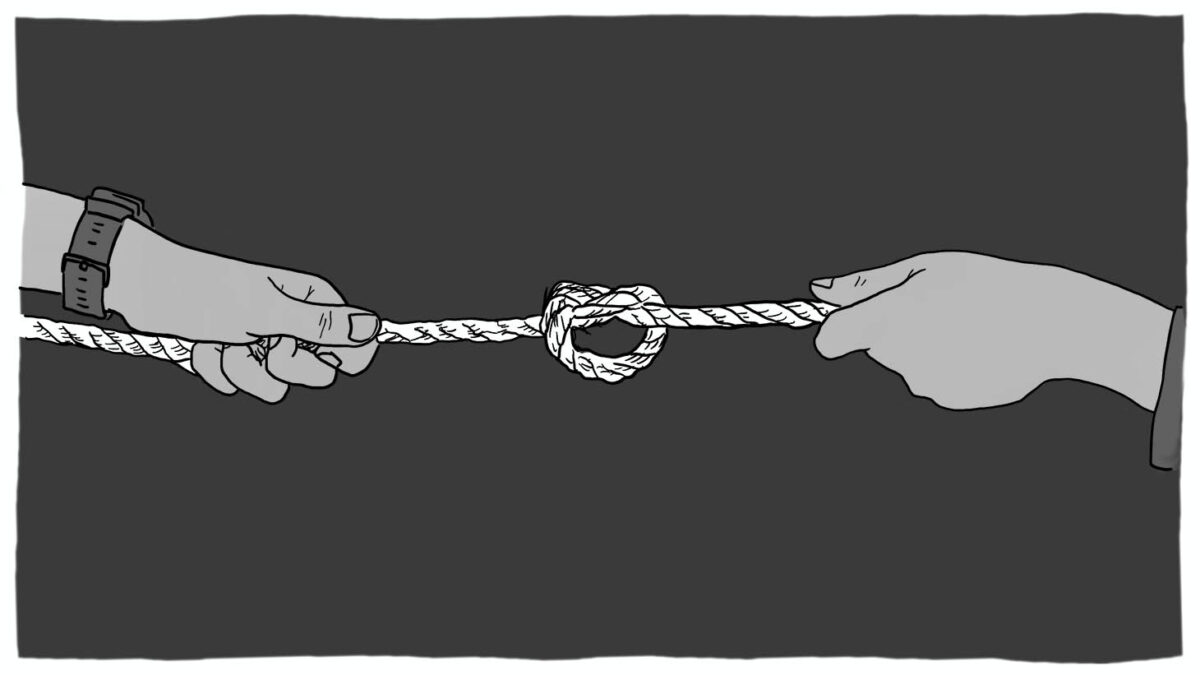
Two hands pull together a rope into a knot

Human relationships are like knots – intricate, tight, and with tangles that can be challenging to unravel. Just as each knot has its unique pattern of loops and twists, each relationship carries its own complexity.

Consider the individual threads you bring to a relationship: histories, expectations, habits, your winning sense of humour…these are aspects of yourself that are uniquely yours. When these intertwine with another person (also with their own distinctive threads), the resultant relationship establishes knots.

Just like any sailor or climber will assure you, knots can either be useful or an obstacle. So too in this analogy with relationship ties. Some connections form gradually through time and shared experiences, establishing strong, resilient, and adaptable connections. Others tighten suddenly during moments of conflict or misunderstanding, forming an obstacle rather than a utility.

They can be beautiful. They can be frustrating. They can be beautifully frustrating.

We’re all unwittingly a part of the fray (no one can live in total isolation). And so the question becomes, how can we work with a tangle in a relationship when things get stuck?


Imagine a balled up mess of string. In haste, we might pull a little here, a little there, a little everywhere – tightening the very knot at the heart of that which we’re trying to untangle.

The first step in untangling a stuck knot is seeing clearly where the complications lie:

And on and on.

Just as yanking on a knot only tightens it further, forcing quick solutions in relationships creates more resistance. And the opposite action of inaction, tends to kick the troublesome mess down the road where it will be even more difficult to work with later.

Effective untangling requires both effort and patience – a willingness to examine each loop carefully before attempting to loosen it. It is the quality of our actions that is important – not the quantity – especially in a tangle.

Slow down. By taking time to find a better understanding of the puzzle in front of us, we can choose an appropriate action from there.

Grid of six different rope knots with human knot titles like partner knot and parent knot

This analogy is getting a little tired, but we’re going to see it through to its end.

Within every relationship knot lies core threads that represent fundamental values and connections. Sometimes we must carefully work through surface tangles to rediscover these essential strands that first brought us together.

So how do we cultivate compassion and peace at a time of tangle, when there is an emotional storm of uncertainty and anxiety? Inclusiveness. Meaning: being able to take on many perspectives, to be open to many views, to notice when we’re imprisoned by our own viewpoint. With this, we can create space – a practice that gets easier with time.

Here are a few tried and true relationship-knot-untangling tips from the Mediation Services team:

  • The gentle pick of bringing curiosity to where the other person’s coming from.
  • The steady pressure of clarifying your own understanding / role / responsibility.
  • The lubricant of compromise to ease tight spots that otherwise just won’t move.

The most meaningful knots – sailor’s knots, Celtic knots, relationship bonds – aren’t simple. Their complexity is precisely what gives them strength and beauty.

The process of working through relationship tangles often creates more resilient and intentional connections. This is why we operate from the root belief that conflict is inevitable and working through it can be an opportunity even when it’s challenging.

In the end, relationship knots aren’t problems to be eliminated; instead, they are intricate patterns to be understood, respected, and occasionally reworked into more functional designs.

Social Media: The highlight reel.

People on their phones around the water cooler

Ah, social media — the place where we connect with others like we used to around the water cooler.

Picture this:

You’re on break at work and swipe open your social-media-app-of-choice for a quick touch-in to feel a little less burnt out. Perfect vacations, promotions, and happy families scroll by and…wait, is that inadequacy you’re feeling? Time’s up and it’s back to work, feeling less refreshed than you’d hoped from the digital hearts and lols.

Does some flavour of this sound familiar? We can’t help but compare ourselves to others.

Social comparison is deeply rooted in our biology and evolution as humans. Our ancestors survived by living in groups, and comparison was a fundamental mechanism for orientation within those groups. It still is, but when doing so online it doesn’t include the full picture.

Think about it: do you share every aspect of your life openly online? Most of us curate the experiences we put out, presenting a polished version of our lives.

The highlight reels of our online profiles belie our more complex existences. And when we mistake someone’s highlight reel for their complete reality, we create a foundation for misunderstandings and conflict.


The psychology behind social media curation

It is a natural human tendency to present our best selves publicly – online, as we’ve mentioned, but notably offline too (when we introduce ourselves to someone at a party, we keep the elevator pitch surface-level). We all know we’re not perfect, but we all want others to see us as doing well. Emphasis in this context should be on all, meaning that when we meet someone new at a party they’re putting their best foot forward too.

Catching ourselves in unfair comparison at a party is one thing, but it’s even more difficult online. Digital communication tends to be devoid of the nuanced subtext of being a human; body language that we unconsciously register is nowhere to be found. Further, there’s the algorithm to contend with: an invisible hand that serves up dopamine hit after dopamine hit of engaging content.

A phone app saying: WARNING! Social media consumption may skew one’s perception of others.

How misinterpretation leads to conflict

Just like a car mirror is plastered with the caution, “Objects in rearview mirror may appear closer than they are,” perhaps a social media app should pop up an occasional warning, “Social media consumption may skew one’s perception of others.” But we all know this would be futile and that, after closing that window a couple of times, we would stop registering the admonishing words.

Conflict will inevitably bubble up, but when it does try to remember: social media’s highlight reels skew our perceptions of others. Your viewpoint might not be accurate.

Since warnings don’t always work, here are some common scenarios to watch for where social media misinterpretations can lead to conflict:

  • Family conflicts arise from perceived lifestyle differences.
  • Workplace tensions form when colleagues appear more successful online.
  • Friendships are tested when social media posts are misinterpreted.
  • Relationships are questioned when partners compare with idealized versions of others online.

We’ve all heard the truthful saying, “Comparison is the thief of joy.” True – and it’s also kindling for division.

When we swipe open our social-media-app-of-choice for a quick touch-in there absolutely are positives beyond the perils we’re alluding to. Still, misinterpretations such as these can (and do) result in real-world misunderstandings and conflicts that need to be managed.


Practical tips for social media usage

And so, without further ado, here are four practical tips for social media users:

  1. Remember that social networking shows life’s highlights, not the complete story.
  2. Initiate direct conversations when feeling triggered by someone’s post.
  3. Practice mindfulness about your own posting habits, reflecting on your motivations and the potential impact of your content rather than posting impulsively or seeking validation.
  4. Take periodic breaks from social platforms – “touch grass” as the elders say (has any elder actually said this!?).

Every single person is multi-dimensional and has a lot going on in life – upbringing and heritage, opportunity and hardship, health and unhealth. What we present to others is never the full picture – heck, even the story of “me” we present to ourselves leaves out all of the aspects we’re unaware of.

There is always more to someone than what’s at the surface.

Digital Communication: The nuance of intention.

A person with four flurried arms holds all sorts of communication devices

The problem with digital communication

Communication is key to relationships, and it’s safe to say that it’s going through an evolution as we do more and more of that digitally. To say that this progress is linear, however, is to overlook the growing pains that come with learning something new.

In our hyper-connected world, we’re sending more messages than ever before. The average person exchanges at least 10 texts daily (source), yet many report feeling increasingly misunderstood. This disconnect stems from what’s missing in digital exchanges: tone, facial expressions, and real-time feedback that humans evolved to rely on for thousands of years.

We’ve attempted to bridge this gap with emojis and GIFs. While helpful, these tools often create their own confusion. A simple thumbs-up emoji, for example, can signal approval to one person and passive-aggression to another. Further, message interpretation varies significantly across generations and cultures.

And then what happens when a miscommunication happens? Conflict! And if it’s not handled well: 😠😭🔥!!!


Intentions matter

“It’s no longer about the intentions of the speaker, it’s how the listener heard it.”

  • Jonathan Haidt

Anyone who has been online or read the news in the last decade can feel the cultural shift that Jonathan Haidt is pointing at. And it’s a reality that is exhausting.

Consider Grandma commenting on your new girlfriend’s appearance at Christmas dinner: “Oh, you’re so pretty, dear! And not too skinny like all those models. You’ve got a healthy appetite – I like that in a woman!”

In person, you can quickly tell if Grandma was trying to be hurtful or just awkwardly complimenting in a way that feels outdated and potentially body-shaming.

Intentions matter – and, most of the time, people aren’t trying to be jerks. We’re very quick to call other people out these days, but there are times when it’s more fruitful to call each other in.

“Grandma,” you might say later in private, “I know you meant well, but commenting on someone’s body or eating habits is not cool. It can make them uncomfortable, even when it’s meant as a compliment.”

And doing so, a fight averted and better place to move forward.

A computer keyboard with emojis as keys

Finding balance in a digital world

Our actions ripple outward and the outside view might not match our own perspective, but that doesn’t diminish the original intention.

A text message is devoid of body language. Was it actually sent curtly, or was it just a quick response amidst a lot of other things going on that day? Were they actually ghosting you, or do they just not get along with technology? Did they actually insult you, or did autocorrect stuff unintended words into their mouth?

It’s best to be careful with assuming anything when filling in communication blanks; instead, ask for clarification when there’s doubt or uncertainty. Try texting back asking for more details or embrace the old-school technology of “a phone call.”

Curiosity is always a good value to bring to the face of a conflict. This goes for both digital and in-person communication, but is more often overlooked in the distanced digital realms than with Grandma at Christmas dinner.


Being a modern human isn’t always easy, but with a little bit of care we can be better suited for the task.

Consider which medium best suits your message. Complex emotional conversations deserve voice or video calls. Quick updates work well as texts. Being intentional about how you communicate can prevent misunderstandings before they start.

And when things do inevitably sometimes bubble up into conflict, recognize that this is natural and try to avoid making it worse by doubling down. A defensive response only leads to division and conversations where people are yelling without listening to each other, when the reality is that it’s quite possible there is a misunderstanding at the root of the issue.

The evolution of digital communication isn’t about abandoning traditional forms, but instead finding a balance between them. By acknowledging both the benefits and limitations of our digital tools, we can communicate more effectively across these mediums and all the ones yet to come.

The Illusion of Simplicity: Underestimating expertise.

A confused character stands on a shape that is an optical illusion

When someone is good at what they do, from the outside it appears as a smooth ride. They do it so well and all the rough edges have been worked out by experience. There is no friction to grab our attention.

A fellow expert sees this and appreciates that this is the refined result of much time devoted to honing their craft. But another person – one who has less experience in the observed realm – might look at the exact same process and mistake it as simple.

As such, mastery can sometimes quietly slip under the radar; the illustion of simplicity belying the careful hand presenting sushi, creating art, or managing people.


We explored the Dunning-Kruger effect in our last article, unpacking the idea that people with the least competence often have the highest confidence in their abilities. But the other side of overestimating your own inexperienced ability, is to underestimate other peoples’ skill.

Rolling sushi, for example, is easy…until we actually try it. When we fumble our first attempts, we typically are humbled pretty quickly and come to respect the skill of a sushi chef – care for ingredients and years of learning to present a simple roll, just so. Unfortunately however, as we get older we don’t throw ourselves into new things as often and so many times we never learn the hard way like this and undervalue other people’s talents more than they deserve.


The illusion of simplicity is a cognitive bias where people underestimate the complexity of a task or situation by focusing only on the most visible aspects – neglecting underlying complexity or nuance. This bias leads us to oversimplify complex problems, resulting in incorrect assumptions and flawed decisions.

“Sure,” you might agree, “I can totally think of examples of where other people have underestimated my talents like this. But I am the exception and don’t make that same mistake.

Not quite! We are all susceptible to this line of thinking because by its nature, it is a blind spot – which, by its definition, is blind. Assuming otherwise leads to a resistance to learning and dismissal of feedback – a place devoid of growth and fertile for conflict.

An illustrated guide on how to make sushi

Let’s consider a workplace example:

A marketing team is tasked with redesigning the company’s website. The project manager, Alex, has some basic knowledge of web design from watching tutorials and attending a weekend workshop. When the company’s experienced web designer, Maya, presents a comprehensive plan that includes user experience research, accessibility considerations, and technical requirements, Alex dismisses many of her recommendations as “unnecessarily complex.”

When Maya attempts to explain why certain technical considerations are critical for discoverability and user engagement, Alex interrupts with, “Let’s not overcomplicate things. We can just use a template and be done in half the time.”

In his rookie mindset, Alex is unable to recognize expertise and believes website design is relatively straightforward based on his limited exposure. He fails to appreciate Maya’s years of specialized knowledge and the complexity underlying the creation of an effective website. He sees only the visible end product without understanding the expertise required to make it function properly and serve business goals – simple in its form, sure, but not because it is simple.

The consequences become evident when the rushed website launches with poor mobile responsiveness, slow loading times, and accessibility issues that alienate customers and harm the company’s reputation.

Whoops – it turns out that when the invisible requisite steps to get to an end goal are missed, we end up somewhere both unexpected and undesired.


There is a risk that comes with not acknowledging the illusion of simplicity. We can try our best, but sometimes we inadvertently overlook the expertise of others which leads to…issues. Beyond websites, this underestimating of others can extend into any of our relationships and breed conflict. What if Alex had responded differently to Maya’s suggestions?

While confict is natural, it’s important to recognize our blind spots and engage with them curiously rather than with defensiveness. This is reason #107 that we recommend everyone enrols in our FREE Conflict 101 webinar. Deepen your education with our specific on-demand program for Dealing with Defensiveness.

We can demystify conflict with a psychological approach, and seeing through the illusion of simplicity is just one of the many opportunities to do so.

The Dunning-Kruger Effect: Living in a bubble of self-deception.

Graph charting confidence against expertise illustrates the Dunning-Kruger effect

Have you ever met someone who was absolutely convinced of their expertise in an area where they clearly lacked basic knowledge? Or perhaps you’ve caught yourself feeling overly confident about a skill, only to be humbled when faced with someone who knows more? You’re not alone. This common psychological phenomenon has a name: the Dunning-Kruger effect.

The Dunning-Kruger effect describes our tendency to overestimate our abilities. First identified by psychologists David Dunning and Justin Kruger in 1999, this cognitive bias reveals a troubling pattern: those with the least competence often have the highest confidence in their abilities.

This isn’t just about a few overconfident individuals. The research shows that this is a widespread human tendency:

  • 42% of engineers at a company rated themselves in the top 5% of performers (link to study).
  • 88% of American drivers consider their driving skills above average (link to study).
  • Similar patterns appear across health knowledge, leadership skills, ethics, and countless other domains.

Mathematically, these self-assessments are impossible. We can’t all be above average – that’s simply not how averages work.


What makes the Dunning-Kruger effect particularly insidious is what Dunning and Kruger called a “double curse”. First, we make mistakes and poor decisions. But second, those very same knowledge gaps prevent us from catching our errors.

This creates a perfect storm of unbeknownst incompetence paired with unwarranted confidence. Without the necessary expertise to evaluate performance in a domain, people simply can’t see where they’re falling short.

The consequence? Perspectives between oneself and others don’t match up, which can often lead to conflict in our relationships.

Consider this college debate tournament study, where the bottom 25% of teams lost nearly 80% of their matches – yet believed they were winning about 60% of the time. Without understanding debate principles, the students couldn’t recognize when their arguments failed.

A similar blindspot occurs when confronting conflict in our homes, workplaces, and communities. We believe we’re doing well most of the time, even though that might not be the case – especially from another person’s perspective. It’s worth noting that this is natural and we all do it. But, unchecked, it is problematic.

A car with a license plate of 'B3ST DRVR' stuck in a tree

Interestingly, the relationship between competence and confidence isn’t a straight line. It typically follows this pattern:

  • Beginners (Low Competence): Often have disproportionately high confidence because they don’t know enough to recognize their limitations.
  • Intermediate Learners: Experience a confidence drop as they learn enough to recognize how much they don’t know. These people often have less confidence than beginners despite having more skill.
  • Experts: Generally have accurate self-assessments of their abilities, but they make a different mistake – assuming others share their knowledge level.

The Dunning-Kruger effect creates a bubble of inaccurate self-perception that affects people at all skill levels. Without experience, we don’t know enough to be able to identify our own faults. And with expertise, we don’t realize how our abilities are exceptional and fail to empathize.

This bubble of self-deception distorts our decision-making. When we overestimate our financial knowledge, for example, we might make poor investment choices. When we think we’re better at reading emotions than we actually are, we misinterpret social situations. Are you starting to see the pattern here? These overconfident self-assumptions can lead to serious consequences in our personal and professional lives.

What makes this effect particularly challenging is its invisibility to those experiencing it. We don’t know what we don’t know, and that blindness feels exactly like expertise.


How can we overcome this psychological trap and gain a more accurate view of our abilities? First, ask for feedback from trusted people (a boss/colleague, a friend, etc), and consider it even if it’s hard to hear. Second, and perhaps more importantly, embrace a beginner’s mind and keep learning no matter our skill level.

A wise approach is to assume that we all have blind spots. With this baseline of humility, we approach our self-assessments with healthy skepticism, and not take corrections so personally.

Remember the old saying: “When arguing with a fool, first make sure the other person isn’t doing the same thing.”

Measuring Progress: Orienteering with a compass.

Footprints in snow walk a non-linear path

So, you’ve set some resolutions as targets and are in the trenches making your way towards them, one determined army crawl at a time. Two days in, you feel pretty good about your efforts. An unexpected reaction blows up and sends dust all over your face; you roll to the side and sidle the crater now in place of what appeared to be solid ground. Two months in…you’re a little uncertain that you’re heading in the right direction anymore.

Emotions get involved with things we care about – especially when uncertainty is involved. They have a funny way of swinging us from one extreme (motivated!) to the other (despair!), making willpower unreliable and skewing our perception of progress.

It begs the question: how can we orient on a long and probably non-linear path from point A to point B?


Consider both a yardstick and a compass; each is a tool that can be used to navigate somewhere. 
A yardstick focuses on measuring distance – how far we’ve come and how far we still need to go. A compass, in contrast, guides by direction rather than distance. When we veer off course, we simply realign and continue forward.

Metaphorically speaking, both of these approaches line up for how we can navigate our goals.

The yardstick, in this case, is rigid measurement which often breeds perfectionism and judging ourselves as failing if we fall even a millimeter short of our idealized destination.

The compass approach, on the other hand, transforms our goals in several effective ways:

A compass held in a hand to orient to north

Sometimes, the process of achieving a goal is slower than we might wish (it certainly does not happen overnight.). Moreover, uncertainty is inherent because not everything is within our control: a job termination, a financial misfortune, a breakup…moments like these are pivotal transitions that leave us scrambling for stable ground.*

When we think we have to figure out everything all at once, the path forward becomes occluded with anxiety and difficult to see. If we try to measure by distance, the numbers loom large and it’s easy to fall prey to catastrophic thoughts.

In such moments we need to reorient ourselves, for the path forward is found through a culmination of small, consistent actions and decisions made day after day. Remember how we can orient to our internal compass and stay steady in following it. We focus our energy on the next small step in that direction, even when we don’t know what the next one will be.


This directional approach naturally aligns with a growth mindset. Challenges become learning opportunities rather than failures, and setbacks are simply moments to reorient ourselves toward our chosen direction.

Wishful thinking can be healthy. It orients us into an uncertain future, allowing us to find hope and possibility in each step. But: it requires many little actions to get there.

Remember: A yardstick measures how far, but the compass in our pocket shows us which way to go.

Mythbusting: The overnight success.

Gather ‘round as we tell a story that’s as old as time: that of The Overnight Success.

After a full day of work, you flop down on the couch and turn on the television to see what you missed in the Olympics. Exuberant text flashes across the bottom of the screen as slow-motion replays show every angle of a moment of glory, and excited announcers exclaim that a child prodigy has broken a record in the 100-meter sprint.

“Wow!” you also exclaim, to no one but you and your cat. But a tinge of comparison prompts further musing: “That’s amazing but…I sure wasn’t doing that at that age (or any age for that matter).” Your cat looks back at you knowingly.

Ah, comparison – also known as the thief of joy.

From an outside perspective, it’s tempting to assume that the Olympic champion was born ready for competition or, at the very least, had their success come easy. And while there undoubtedly are factors of talent / genetics / opportunity at play, once upon a time every Olympian was a toddler wobbling across the floor just like the rest of us.

Even for a toddler’s first steps, it might seem like the little one just stood up one day and decided to walk – but this overlooks all of the efforts that led to that pivotal moment. While the path to gold medal glory is a few steps beyond this, it’s not so different in that there were many unseen steps taken before a goal was achieved.

The myth of overnight success leaves out all of the muscle development, failed attempts, bruised knees, and determination it took to reach the milestone.


Success doesn’t happen overnight. To assume so discredits the hours / years / lifetime of hard work that added up to it. Yet, often we compare our messy work-in-progress with others’ final results. Not only is this unreasonable, it also saps our personal willpower and motivation when it comes to learning new things – because how can we measure up?

We can see this when it comes to conflict – or rather, when we’re learning to deal with conflict better. The path to progress is nonlinear with many peaks and valleys. When it gets difficult or you make a mistake, it can be tempting to conclude that it’s simply not your strength. Better to leave it to the experts (gestures nebulously towards the Mediation Services team) and give up.

But let’s not jump to conclusions prematurely.

Drops of water into a cup adds up

Recognizing when we’re getting down on ourselves because of an unreasonable comparison is important because it leaves out the wholeness of someone else’s experience. When this happens, remember that what might appear as sudden mastery is actually the culmination of developmental building blocks stacked one upon another.

Just as a child doesn’t suddenly wake up knowing how to read, other skills don’t arrive fully formed. They are built through daily efforts, stumbles, and small victories – moments when no one is watching and progress can seem frustratingly slow. Developing mastery comes not because there weren’t any setbacks; it comes because we stick with it despite the setbacks.


It is indeed daunting to stay consistent in our efforts, but the good news is that you aren’t alone in the challenge of learning new things. It’s just a part of it – and empathizing with others in this helps us understand the broader arc of life and that they too have faced this frustration (gestures nebulously towards the Mediation Services team). Action beats waiting for motivation, and understanding this shared humanity serves as a healthy personal inspiration to show up.

There’s no escaping the time required to refine skills, which extends beyond our physical abilities to our role in relationships. With time, we can become a better athlete. With time, we can become a better partner, friend, and colleague. This iterative process is the key to growth, and it’s done quietly and often without public recognition.


We’ve used a lot of different examples to unpack the idea of overnight success. One our team obviously specialize in is conflict resolution, and in this we invite you to join us for a training (online or in-person) to kickstart your learning in that regard. It comes with homework: applying it to your life. But don’t worry, if you have questions or your efforts fall flat, we’re here to support in whatever way we can if you need it (contact us here).

The story of overnight success isn’t about a penultimate moment of triumph, but about the countless hours of development that made that moment possible. It’s about understanding that every great achievement is simply the visible peak of a mountain of effort, determination, and persistence.

So let’s get inspired to attend to difficult things! Career, finances, relationships – just like learning to walk or becoming an Olympian, individual moments in the various facets of our lives add up to the longer arc of success.

If you have questions,
please don’t hesitate to call.

1-204-925-3410

Subscribe To Our Newsletter

For The Latest News & Updates