Announcement: Effective Feedback on-demand webinar!

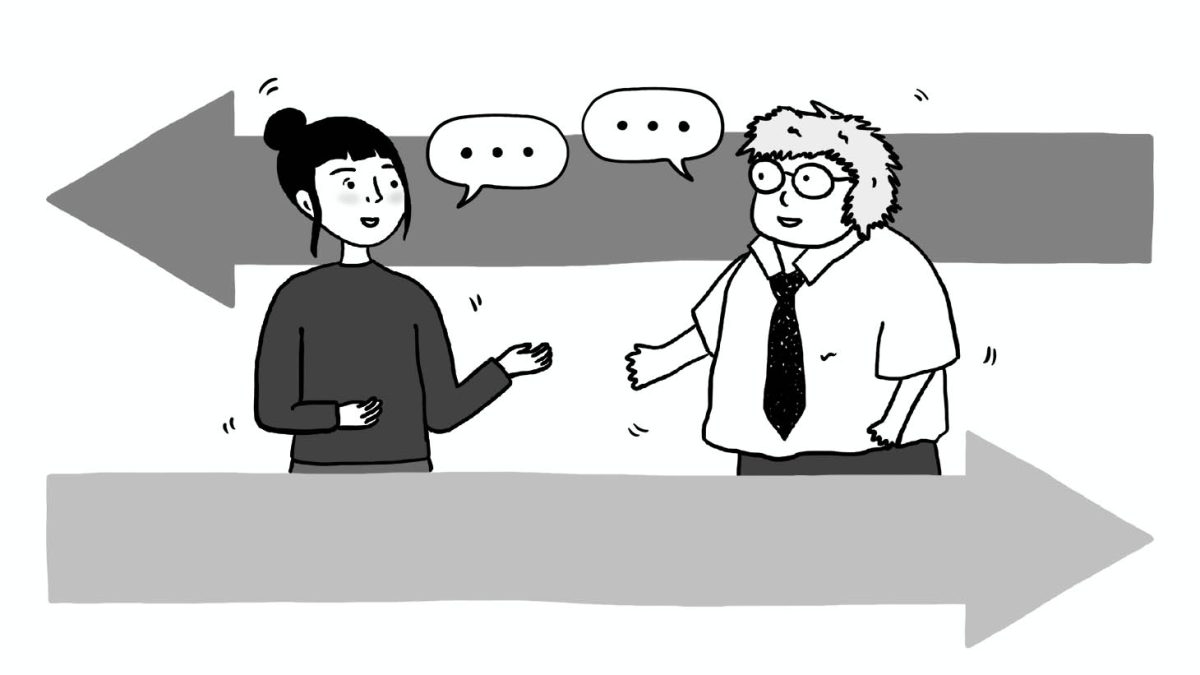
Two people having a conversation with arrows going both ways

Have you ever been served a feedback sandwich?

You know the recipe: a slice of praise, a thick layer of criticism, and another slice of praise to finish it off. It’s a popular dish in workplaces everywhere, and the logic seems sound – soften the blow, keep things positive, and everyone walks away happy.

Except that isn’t how it goes. People remember the criticism and forget the compliments around it. Or put another way: a mud sandwich tastes like mud, even if the bread is good.

Giving feedback well is one of the trickiest skills there is – and it matters at work, at home, and everywhere in between. Which is why we’re thrilled to announce that our Effective Feedback training is now available as an on-demand webinar (enrol here).


Why feedback goes sideways

Most of us don’t avoid giving feedback because we don’t care. We avoid it because we’re worried about hurting someone, sparking an argument, or making things awkward in a relationship we value. So we drop hints. We hope the problem fixes itself. We complain to a colleague down the hall. And the little things quietly add up.

Meanwhile, the other person has no idea anything is wrong.

For leaders, the stakes are even higher. Handling these conversations well is often the difference between a struggling team and a thriving one. And a conversation that starts out about missed deadlines can turn up something deeper: a family crisis, a mental health struggle, or plain burnout.

This webinar is about having the hard conversations – and building a culture where they’re expected and received well. You’ll learn how to clarify expectations, describe behaviour without judgment, adjust your approach for different personalities, and respond well when defensiveness flares up.


How it works

Your guide through Effective Feedback is mediator and trainer Janet Schmidt, who has been facilitating difficult conversations since 1986. Janet is also the guide behind our Dealing with Defensiveness webinar – and the two courses are designed to work together. In fact, Effective Feedback includes access to Dealing with Defensiveness, and pauses partway through so you can take a detour into defensiveness before tackling the harder conversations.

Here’s what’s included:

  • 71 bite-sized lessons across five sections, with video lectures and demonstrations.
  • A downloadable 90-page training manual with worksheets, conversation templates, and practice scenarios.
  • Reflection questions that ask you to apply each tool to real situations in your own life.
  • Flexibility: start anytime, learn at your own pace, and revisit it whenever a tough conversation is on the horizon.

It’s especially valuable for supervisors, managers, and team leads – though anyone who has ever needed to say something difficult to a colleague, neighbour, or family member will find plenty to take home.

Prefer to learn in a room with other people? Effective Feedback started as an in-person workshop, and it’s still offered here in Winnipeg, with upcoming sessions on December 3 and 10, 2026, and April 20 and 27, 2027. See all our upcoming in-person courses.


Feedback doesn’t need to be a mud sandwich. Done well, it’s one of the most caring things we can offer each other – honest, specific, and delivered by someone who clearly wants us to succeed. As a school principal quoted in the course manual puts it, "Real accountability isn’t a ‘gotcha moment’. It’s an ‘I see you’."

Enrol in Effective Feedback today and start having the conversations that matter.

Note: Already taken Dealing with Defensiveness? Contact us about a discounted option.

The Long Shadow: How conflict gets passed along.

One person casts a long shadow to the edge of the frame

Acknowledging division

When divisions get deep, it becomes difficult for those involved to reimagine being in relationship with people who have caused damage.

Facing this time and again, John Paul Lederach (a changemaker in the fields of peacebuilding and conflict transformation) arrived at a deep driving question: How do we make our way back to a sense of our shared humanity, when it has been so harmed?

What makes this question so complex is that in many of the situations Lederach has worked in, the harm wasn’t recent. It wasn’t a single incident that could be traced to a specific moment and addressed there. It was cyclical. It had a quality of repetition that stretched beyond the person vocalizing the divide – not just the immediacy of what was unfolding in the moment, but the long shadow of everything that had unfolded before, absorbed into memory and identity, and spread like an inheritance nobody chose.

These sorts of conflicts are present across all interpersonal scales – not just the ones that make global headlines. Here at Mediation Services, we witness many cases where cyclical conflict plays a part in families, workplaces, and local communities.


Conflict as inheritance

Some wounds heal cleanly. There’s a harm, a reckoning, a repair – and life moves forward. But anyone who has worked closely with conflict knows that this is not always how it goes. Some conflicts don’t resolve; they settle. They go underground. And then, in time, they surface again – in a new form, carrying the weight of everything that came before.

We tend to think of inheritance in terms of what’s given to us deliberately – values taught at a kitchen table, stories told on purpose, wisdom offered with care. And much of what passes between generations is exactly that. Our elders shape us. They give us language for the world, frameworks for understanding who we are and who we belong to, a sense of what matters and what threatens.

But inheritance is not always conscious. And it is not always kind.

Children absorb far more than they are told. They read the tension in a room before they have words for it. They learn which names make the adults go quiet, which histories are treated as settled facts rather than open questions, which groups of people are spoken about with suspicion or contempt – and which with warmth. Long before a child can articulate a worldview, they begin to inhabit one. And woven into that worldview, often invisibly, are the unresolved conflicts of the people surrounding them.

This is how cycles begin. Not with a decision to perpetuate a grievance, but with the simple, human process of learning from the people we trust. We inherit their fears alongside their wisdom. We absorb their wounds alongside their warmth. And if those wounds were never truly addressed – if the harm was buried rather than healed, if the other side was never restored to full humanity in the family’s imagination – then the conflict travels forward, intact, into a new generation that didn’t choose it but now carries it.

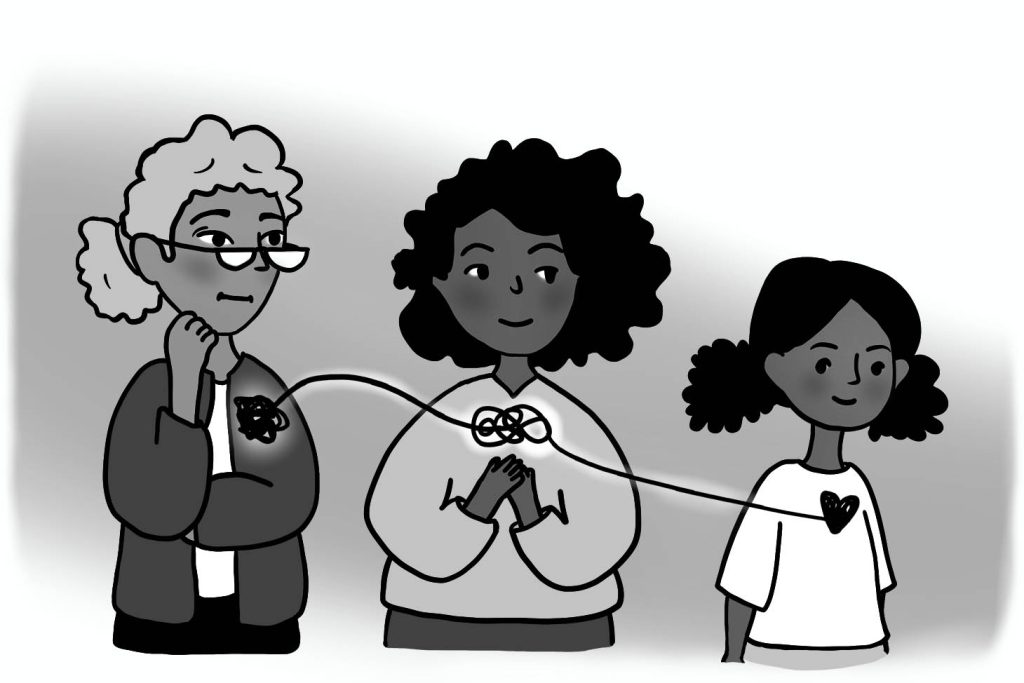
Grandmother, mother, and grandchild hold a thread that goes from a tangled mess to a heart across generations

Closer to home

It’s tempting to locate this pattern exclusively in the conflicts that make history books – the intergenerational ethnic divisions, the cycles of political violence, the national traumas that reshape societies. Those are real, and Lederach’s work has taken him into many of them. But he is careful to note that the mechanism is not unique to those scales. The same dynamic, the same transference of unresolved harm across generations, plays out in families, in workplaces, in faith communities, in neighbourhoods.

A family that never found a way through a particular rupture – a betrayal, an estrangement, a deep unfairness that was papered over rather than repaired – can pass that rupture forward for decades. Children grow up knowing there are people they don’t speak to, without always knowing why. They learn the contours of the conflict before they learn its content. And in time, they may find themselves defending positions they inherited rather than chose, in a dispute that predates them.

Workplaces carry similar patterns. Organizational cultures hold memory. A team shaped by a period of poor leadership, broken trust, or unaddressed harm develops habits of guardedness and suspicion that can persist long after the original circumstances have changed. New people arrive and are quietly socialized into old conflicts they had no part in creating. The cycle continues not because anyone decided to continue it, but because no one found a way to stop it.


When reimagining relationship feels impossible

What makes cyclical conflict so resistant to resolution is the way it forecloses imagination. When divisions go deep – when harm has accumulated across years or decades or lifetimes – it becomes genuinely difficult for those involved to picture being in relationship with the people on the other side. Not just uncomfortable, not just unfamiliar. Unimaginable.

This is part of what makes the “How do we make our way back to shared humanity?” question so demanding. It’s not just asking people to forgive, it’s asking them to revise a story they’ve been living inside – sometimes for years, sometimes for longer. It’s asking them to see, in the people they’ve been taught to see as the other, something of themselves.

That is a profound ask. And it cannot be rushed, legislated, or imposed from the outside.

In a previous article, we’ve covered in detail four qualities of imagination that help us find ways through protracted conflict and we recommend reading it in full. It’s an actionable starting point for breaking the cycle of conflict, one that lets us introduce a future into a situation that has often become trapped in the past.


Breaking the cycle

Cycles are broken not by forgetting what came before, but by refusing to let the past be the only thing that determines what comes next. That distinction matters. Healing doesn’t require pretending the harm didn’t happen. It doesn’t require skipping over grief or anger or the legitimate need for accountability. It requires something harder and more specific: the gradual, often painful work of keeping the humanity of the other person visible, even when everything in the inherited story says they don’t deserve it.

In practice, this often starts small with a conversation. A willingness to ask a question instead of making an accusation. A moment in which someone from one side of a long division says, takes a stance of curiosity and says simply: tell me what it was like for you. And listens.

These moments don’t end cycles on their own. But they interrupt them. They introduce something new into a pattern that has been repeating. And in Lederach’s experience, they are often the beginning – the first small step by which communities, families, and organizations start to find their way back to something that resembles shared humanity.

The cycle is not inevitable, but breaking it requires someone to choose to do something different with what they’ve been handed.

Peacemaking: Imagination, courage, and smalls steps.

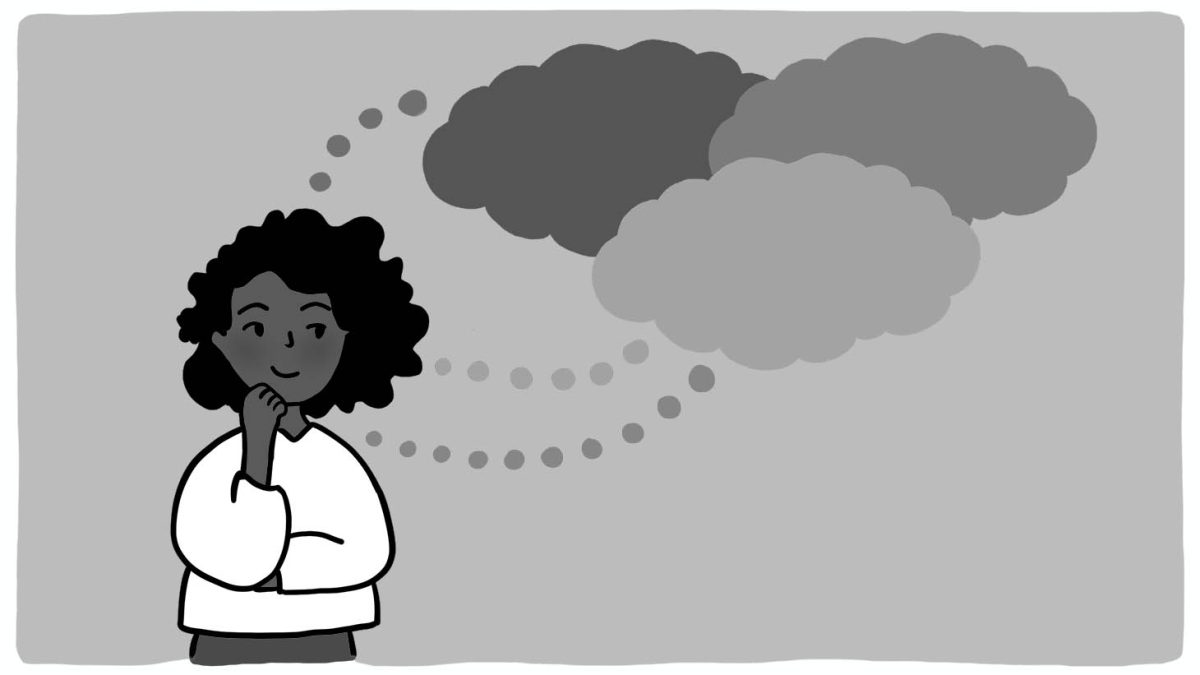
A woman with three different thought bubbles around her

There’s a version of peacemaking that looks like a negotiation: two parties, a table, competing interests, and a deal to be struck. Get the incentives right, apply enough pressure, and an agreement emerges – problem solved.

John Paul Lederach has spent nearly fifty years watching this version often fall short – not because negotiation is useless (he has been at those tables), but because it tends to address the surface of conflict while leaving the deeper ground untouched. Real peacemaking, he argues, is closer to an art than a transaction, and it requires a particular kind of imagination that can’t be reduced to technique.


Four forms of imagination

In his book The Moral Imagination, Lederach identifies four qualities of imagination that he observed consistently in communities that found ways through protracted conflict. Together, they sketch a picture of what this art form actually looks like in practice.

  • The grandmother’s imagination: A simple recognition that the well-being of my grandchildren is tied to the well-being of those I consider my enemy and their grandchildren. You cannot separate them. This is not a sentimental claim, it’s a structural one. It means entering conflict with an imagination wide enough to include the humanity and the future of those on the other side of the divide.
  • The imagination of curiosity: The surface of a conflict is rarely all that it seems. Curiosity about the other side’s perspective – their history, understanding, details left unsaid – and getting clear with active listening are key practices to having a conversation that can move forward.
  • Artistic imagination: Approaching peace as creative work – bringing it into existence where it does not yet exist – rather than technical problem-solving.
  • Imagination of risk: Every step forward comes with risk (reaction, retaliation, exposure). In each moment, take just one step and don’t get paralyzed looking to far forward. Little steps add up.

There is no checklist for moral imagination, no certification that confirms you have acquired it. These four qualities are more like orientations and dispositions that have to be cultivated over time, often through failure.

For those of us working in conflict resolution at any scale – whether in boardrooms, classrooms, or across kitchen tables – this is both an encouragement and a challenge. The encouragement is that peacemaking doesn’t require a perfect process or a perfect facilitator. It requires people willing to hold a wider frame than the conflict itself and touch into a sense of empathetic understanding.

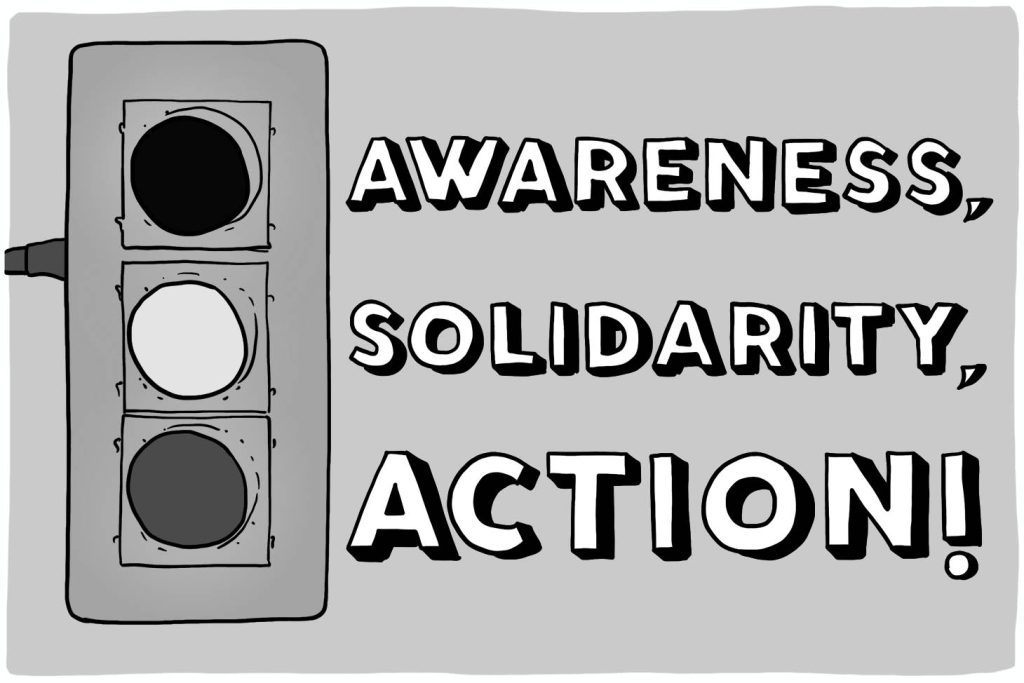
A traffic light flashing red for awareness, yellow for solidarity, and green for ACTION

Compassion as action

Compassion isn’t just an emotional state or a feeling of sympathy. It’s a three-part practice:

All three matter. Awareness without solidarity is isolation. Solidarity without action is sentiment. And action without awareness risks doing harm in the name of good.

But together, these three – in small, specific, present-tense doses – are what peacemaking actually looks like from the inside. Not grand gestures. Not historic accords. Just this: paying attention, reaching for a hand, and taking the next step that’s in front of you.

Peace is not something that gets built once and stands. It’s something that has to be continually made, by people willing to imagine it into existence.


Further reading

This article is a continuation of a series of blog posts based on the peacemaking work of John Paul Lederach. Before diving in here, it might be useful to reread our first one on Dehumanization: How ‘we’ and ‘they’ slowly break community and the second on Conflict Transformation: Peace begins where we can still reach each other.

More to come soon.

Conflict Transformation: Peace begins where we can still reach each other.

Differing groups of stick-figures are in separate circles with lines drawn between them

There’s a particular kind of helplessness that sets in when the news is bad enough for long enough. A war that won’t end. A community fracturing along lines that feel older than anyone involved. A workplace or organization where the damage has gone deep and the people with the power to fix it don’t seem to be trying.

We see it. We feel the weight of it. And gradually, without quite deciding to, we go quiet. We wait for someone else to do something – a leader, an institution, a process…anything. And over time, if there is no resolution, the waiting starts to feel like the only option available.

John Paul Lederach has a name for this: paralysis. And after nearly five decades accompanying communities through some of the world’s most entrenched conflicts, he’s come to believe that paralysis is one of the most underestimated obstacles to peace.

It’s not because people don’t care – usually they care enormously. But because the scale of what’s broken can make the things within our reach feel too small to matter.

They aren’t.


The gap between the global and the personal

In his research into how societies recover from protracted, large-scale conflict, Lederach and his colleagues noted a persistent problem at both ends of the spectrum.

At the national or global level, formal peace processes – accords, reconciliation commissions, official negotiations – consistently felt abstract and remote to the people most affected by the conflict. Leaders would announce progress, frameworks would be established, and ordinary people living amid the actual damage would shrug. Their felt sense was that peace had nothing to do with them individually; that they had no voice in it, no access to it, and often no reason to trust it.

At the other end, deeply personal healing – working through individual trauma, processing grief, rebuilding a sense of safety – is necessarily individiualized for each of us. Everyone moves at their own pace and in their own way. You can’t choreograph it, and you can’t wait for everyone to be ready at the same time before anything begins.

So you have enormous distance at one end, and enormous variation at the other. And in between, a gap where much of the real work actually needs to happen.


The community as the working field

What Lederach and his colleagues proposed to fill that gap is something they call social healing – and the terrain where it happens is the community. Not the nation and not the individual, the community is a space within which practical conversation is possible, where people can speak and be heard, where relationships exist that can be worked with. This working field is close enough to matter and wide enough to ripple outward.

The preferential option for the community is a deliberate choice to locate the work of peacemaking in the middle distance, where people have actual access to one another. We don’t wait for conditions at the top to change and we don’t leave each other to individually process harm alone. Instead we gather in the spaces we already inhabit and begin there.

It’s a modest-sounding idea. In practice, it’s quietly radical – because it means that the work of conflict transformation doesn’t require permission from anyone above you. It doesn’t wait for a ceasefire or a policy change or a new administration. It starts with the people in the room.

A circle of people talking and listening to each other

What "starting where we can reach" actually looks like

In conflict transformation practice, this principle takes very concrete forms.

It might mean creating a space where two colleagues who’ve been avoiding each other finally sit in the same room with a third person present. It might mean a facilitated conversation in a neighbourhood where a particular incident has seeded divisions. It might mean a restorative circle in a workplace where harm has been done and the formal process has run its course, but something still feels unfinished.

None of these are small things for the people involved, but also none of them require solving a larger-than-life systemic problem first. They start where the people involved have access – to each other, to the conversation, to the possibility of something shifting.

This principle is at the heart of the role that Mediation Services endeavours to serve in the Winnipeg community.

It’s important to not romanticize this. Local conversations are not a substitute for structural change and community healing does not make injustice acceptable. Work on the larger systems at play still matters, but the immediate conversations play their part in driving action. They accumulate – building a different kind of relational culture, one encounter at a time. And that culture, over time, is what makes larger change possible and sustainable.

The power of small wins is a very real part of achieving big changes here, just as it is with pointing ourselves towards ideals.


The significance of actual conversation

There’s something worth naming directly here, because it’s easy to underestimate in an era saturated with communication: an actual conversation – in person, in real time, with the real people involved – does something that no statement, post, or broadcast can replicate.

The simple act of having a conversation makes the other person specific. It makes them present, it interrupts the process by which conflict turns people into symbols of whatever we’re afraid of or opposed to, and it restores them to being a particular human being – in this room, saying these words, with this history.

This restoration – a return to the specific – is where rehumanization actually happens. In the room, in the conversation, between people who have chosen to be there together and agreed to try.


Starting where you are

For Mediation Services, this is the whole argument for why our work in conflict transformation and restorative justice matters – and why it doesn’t have to wait.

The conflicts worth addressing are not only the ones that make the news. They’re in the organizations you work with, the families you walk alongside, the community spaces where people have stopped talking or started talking past each other. They’re proximate, and they’re reachable.

Our invitation to you is to resist the pull of paralysis – the sense that because something seems broken at a scale beyond our reach, the breakage directly in front of us isn’t worth addressing. It is worth addressing. It is, in fact, the only place any of us can begin.

Peace doesn’t start at the top and trickle down, it starts in the conversations that are still possible. It starts where people can still reach each other – and that’s closer than we think.


More to come

We’re in the midst of writing several blog articles on peacemaking. The first was on Dehumanization: How ‘we’ and ‘they’ slowly break community – and we highly recommend giving it a read if you enjoyed this current topic.

More to come – stay tuned.

Announcement: The 2026-2027 in-person training lineup is live!

Calendar with circled date labelled WORKSHOP

Have you ever found yourself wishing you were better equipped to handle conflict? You’re not alone, and it is with this in mind that we have put together our 2026-2027 training calendar (now available online).

If conflict is inevitable (it is), then training is the preparation to dance with it a little more elegantly. What might life look like if some mediation groundwork were a more integrated part of being in the workplace, community, and family? It’s not hard to imagine a situation where things went sideways – but it doesn’t always have to go that way. With the right tools and knowledge, a different direction is possible, and the team at Mediation Services has experienced this magic time and again.


Planning and certificates

For decades, Mediation Services has been developing a myriad of different training programs in efforts to serve the Winnipeg community. Our in-person offerings are an integral part to these opportunities.

There are a range of options to suit different levels of commitment and interest. Each course is designed to be suitable for people doing them individually, but there also is the opportunity to earn a certificate by completing multiple courses as organized into different program curriculums:

Full certificates will empower you with a wide suite of skills and knowledge, but they are not always necessary. Start simply with just one course – say, From Bystanders to Allies or Transforming the Argument – and focus on building skills most relevant to you. Then, if you want to continue working towards a full certification for something like a career shift, you can take the next steps from there.


This year’s lineup

Here is this year’s training lineup at a glance, but please click through for each course’s full and up-to-date details:

*This initial lineup is subject to change, so please visit the workshop pages directly for up-to-date details.


Real Learning, Real Results

Tens of thousands of people have trained with Mediation Services over the years. Many return again and again – not just because the material is strong, but because it actually works in real life. From office politics to family tension to big life transitions…these courses help you to show up, better.

Ready to start? Explore the full 2026–2027 schedule today: 👉 https://shop.mediationserviceswpg.ca/

Have a question or need help choosing a course? Reach out to get in touch and let’s chat. We’re happy to help you find your fit.

Invitation: 2026 Annual General Meeting.

Annual General Meeting sign silhouetted by raised hands

Dear Valued Friends of Mediation Services,

Please save the date for Mediation Services’ Annual General Meeting on Wednesday, June 24th at our Winnipeg office (302-1200 Portage Avenue), for this time of reporting back and sharing. Light refreshments will be served at 4:30 pm, and the meeting will start at 5:00 pm. All are welcome!

Join us as we reflect on the successes and challenges this past year across our four core program areas: Restorative Justice Diversion, Community, Family Resolution, and Training. It is also a great opportunity to connect with the community.

Please RSVP and confirm your attendance by emailing us at info@mswpg.ca or calling us at 204-925-3410, and we will be sure to reserve a seat for you.

Your participation is at the heart of our organization and the community it serves. Active involvement in the discussions and decision-making processes demonstrates the strength and dedication of our community.


Also, we encourage you to sign up for our newsletter to ensure you never miss out on our future events, updates, and valuable insights. It’s a great way to stay connected with Mediation Services and be part of our ongoing journey.

We look forward to another year of growth, learning, and positive impact together.

Warm regards,
The Whole Team at Mediation Services

Dehumanization: How ‘we’ and ‘they’ slowly break community.

A Line Drawn Between Two Groups

Most of us would bristle at any proximity to the label “dehumanization” – that’s what happens in genocides, hate movements, and the ugliest chapters of history. It’s something extreme people do. It isn’t something we do.

But John Paul Lederach, one of the world’s foremost practitioners of conflict transformation, would gently push back on that assumption. After nearly five decades working in some of the most violent and protracted conflicts on the planet (ethnic, religious, cross-cultural, and political in nature), he’s come to a striking conclusion: dehumanization doesn’t announce itself. It hides in the most ordinary corners of our lives.


The slippery slope to dehumanization

Social groupings are a normal thing. When you’re part of a group, you have a certain identity which distinguishes you from other groups. We locate who we are by comparing ourselves with others. Much of this has a natural quality to it, but there comes a point at which polarization – that identity tied to a group – becomes toxic.

A key sign that natural grouping is shifting towards toxicity, is the slow descent into dehumanization; in other words, into humiliation: othering in a form that negates and invisibilizes the shared humanity of other people across our relationships and across this globe.

This dehumanization happens in a slippery, often unnoticed way – even as we participate in it. We tend to recognize it only if we see it in its most extreme forms, when it’s labelled racism, sexism, or the ilk that negates the very notion that the “other” is a fellow human being.


Language as a bellwether of dehumanization

One of the clearest early signals that conflict is intensifying is a shift in language. Conversations that once dealt in specifics – this person, this situation, this harm – begin to shift into generalities. The particular dissolves into the categorical, the pronouns becoming “we” and “they”.

It sounds almost too simple to matter. But pay attention the next time you’re in the middle of a difficult disagreement – at work, in a family, in a neighbourhood dispute, or in a conversation about local politics. Notice how quickly the language slides from "I experienced this" to "they always do that." Notice how a whole group of people gets compressed into a single, undifferentiated “them”.

This shift towards generalization is where dehumanization quietly begins. Not with hatred, necessarily. Often just with fatigue, or frustration, or the very human need to make a complicated situation feel simpler. But the effect is the same: real people, with real complexity, get flattened into a category. And categories are much easier to dismiss, to blame, and eventually to harm.

DEHUMANIZATION rewritten to REHUMANIZATION

The word we don’t have

Here’s something worth sitting with. Our dictionaries have an entry for dehumanization. We have research on it, language for it, and whole fields of study devoted to understanding how it happens. But most dictionaries have no entry for rehumanization – the process of finding our way back.

There is a gap here. We’ve become fluent in describing the descent. We haven’t developed nearly the same vocabulary – or the same imagination – for the return.

This asymmetry matters, because it shapes what we pay attention to. If dehumanization only counts when it reaches its most extreme and recognizable form – overt racism, targeted violence, systematic oppression – then we miss everything that leads there. We miss the slow drift, we miss ourselves in it, and we miss the opportunity to course-correct before things escalate further.


Rehumanization in our daily lives

Rehumanization is the act of restoring human qualities to others. The work begins where we have access – in the conversations we’re actually part of, with the people we’re actually connected to.

That means noticing when our own language is drifting toward the categorical. It means asking, when we find ourselves thinking in terms of “those” people: who, specifically? What do I actually know about them? What am I assuming?

It means, in short, practicing a kind of deliberate particularity – refusing to let conflict flatten the people around us into symbols of whatever we’re afraid of or angry about. Instead, it means bringing compassion, patience, and humility to the conversation. These qualities aren’t reserved for diplomats (or even professional mediators).

None of this is easy. But the small, quiet work of rehumanizing others in our minds and in our language is not incidental to peacemaking. It is peacemaking – available to all of us, starting right now.


More to come

We have several more blog articles on peacemaking planned for publication in the coming months. This is just the start – stay tuned.

Disrespect: To engage or not to engage?

A puzzled person stands looking at two diverging arrows

Disrespect happens. No question about it. But when it does: to engage or not to engage? That becomes the real question.

Let’s quickly review what disrespect is:

Disrespect is about behaviour – disregard for the feelings, wishes, rights, and traditions of others.

Note that disrespect often happens without us intending or realizing it because respect is in the eye of the beholder.

With this in mind, let’s circle back to the original question: when disrespect happens, should we engage with the person at the source of it? Or, putting it more personally, what would you want a colleague to do if you had offended them?

When we pose this question in our Building a Respectful Workplace workshop (available online or on-site), we consistently find that people want others to come talk to them. Their reasoning: “I didn’t know I offended them, so how am I supposed to deal with it unless someone comes to tell me?!”


Every time we experience a moment of disrespect, there are two common patterns that emerge:

  1. Silence: This includes a variety of responses that don’t address the issue with the source. We often do this because we are not certain how to respond, or we are afraid of making the situation worse. Paradoxically, one of the ways that exacerbates silence is talking about the situation with those who are not directly involved. These people will try to soothe us, which inadvertently leads us to not address the situation at its source. Silence can also lead to more rumination, which encourages us to hold on to the harm that has been caused, resulting in increased stress and suffering.
  2. Aggression: Our discomfort can leak out in acts of aggression, both subtle and not-so-subtle. It can start with small ways of avoiding or excluding someone because we no longer feel safe with them. In some cases, it can also include challenging back in an aggressive way, resulting in escalation and our own acts of disrespect (this is not the same as being assertive).

Though there may be some wisdom in ignoring a first moment of disrespect or incivility, in most cases the only healthy options are to let it go (forgiving the moment – forever) or to talk about it. Letting a particular situation go only works if you do not hold the situation against the person and start responding to them differently.

A group of people stand chatting amongst themselves

If we would want other people to tell us when we’ve offended them, it’s probably the right thing for us to do the same for people who’ve offended us. Still, actually doing so feels risky. In speaking up, there is a real possibility that they won’t respond well – potentially turning it around, accusing you of something, and opening up an unexpected can of worms.

But there’s also a risk that comes with deciding to do nothing. If we don’t speak up and let the other person know what’s going on internally, the behaviour isn’t likely to change (and little acts of disrespect add up). We need to create an opportunity to actually fix the issue at hand when the other person isn’t aware of it.


We encourage engagement, instead of procrastination and avoidance.

Engagement needs to be done skillfully for it to be effective (and to not make things worse!). In a sense, that’s what our entire blog is about – sharing tools and developing skills to better handle the inevitable disrespect and conflict that arises at work, at home, and in our communities. So as for the “how to’s”, please browse it to find ideas that work for you.

For the purposes of this article, we’ll instead point out a few times where not engaging is the wise choice:

  • If defensiveness arises (in us or the other person), stepping back and returning with clearer heads is the wiser choice.
  • Engagement is a practice for relationships that exist outside of the offending moment, not a crossing of paths with a stranger you’ll never meet again.
  • There is a cultural norm to not directly engage, and doing so would be perceived as aggressive.

Intrigued and want to learn more? We’ve got structured online webinars on Dealing with Defensiveness and Building a Respectful Workplace that you can start today. Or, if you’re more of an in-person learner, check out the upcoming trainings offered here in Winnipeg.

As we’ve already mentioned, there is plenty of free content for you to dig further into on our blog or through our Conflict 101 webinar.

Whichever way, we hope you’ll join us in continuing to learn more about being in relationship with family, community, and work.

Board of Directors: Annual call for nominations.

The team leans out windows and waves at each other

Did you know that Mediation Services is governed by a Board of Directors? This team consists of volunteers from many sectors of the community who are responsible for our strategic direction, property, and funds. Together, they embrace our organizational values of care, collaboration, empowerment, and integrity.

Board positions are annual, and we put out a call for nominations every spring at the following “Get Involved” link:
https://www.mediationserviceswpg.ca/get-involved/board-of-directors/


Governance And Operations

Our Board Policy Manual (updated every three years) is kept up-to-date alongside the list of current board members here on our website (it gets updated every three years), but it’s worth reiterating the heart of its role at Mediation Services.

The Board of Directors focuses on big-picture direction rather than day-to-day operations. The Board’s role is to ensure we stay true to our vision, mission, and values – and that we operate in a fiscally responsible, legally compliant, and ethical manner.

The Executive Director is the Board’s sole employee and is responsible for leading staff, managing programs, and turning the Board’s strategic directions into real-world impact. The Board sets high-level policies, regularly evaluates its own performance, and conducts an annual evaluation of the Executive Director to make sure the organization is well run.

A strong commitment is embodied to facilitate a respectful workplace, consensus-based decision making, and transparent governance practices. This includes clear policies on conflict of interest, fiscal responsibility, and community engagement.


Our Direction For The Future

With member input, the Board has adopted the following three current strategic directions:

  • Specialists: Be a hub of specialists in restorative justice.
  • Awareness: Amplify the voice of restorative justice in Manitoba and beyond.
  • Partnership: Enable the prevalence of restorative justice by working with others; make it the preferred and natural choice.

For community members, this means Mediation Services will continue to be a place where conflicts are met with compassion and structure, where people learn new skills, and where justice is understood as restoring relationships rather than simply assigning blame.

If you are interested in joining the Board now or in the future, please keep an eye on the Board of Directors nomination page (under the “Get Involved” menu dropdown) and watch for a call for nominations each spring (typically in March/April).

Clarity: Cutting through the cloudiness of conflict.

A banner declares "Clear is Kind"

“Clear is kind,” they say, but the lingering sting from a blunt correction is something we’ve all experienced. Clear, sure – but kind? The words might not initially ring true.

The phrase "clear is kind" comes from researcher and author Brené Brown, who popularized it in her work on leadership and vulnerability. Brown argues that being clear in our communication (even when it’s uncomfortable!) is ultimately an act of kindness because it respects the other person enough to tell them the truth. The alternative, she suggests, is far worse: unclear feedback wrapped in false politeness that leaves people confused, anxious, and unable to improve.

Brown contrasts this with what she calls "unclear is unkind." When we soften our message so much that it becomes vague, or when we avoid difficult conversations altogether, we’re not actually being kind – we’re being self-protective. We’re prioritizing our own comfort over the other person’s right to know where they stand. The result is often a slow erosion of trust, as people sense something is wrong but can’t quite name it or address it.

Think about a manager who tells an employee, “You’re doing fine,” when performance is actually slipping. In the short term, the manager spares them embarrassment. But when a promotion passes them by or a performance review reveals hidden dissatisfaction, the message stings much more deeply. The initial vagueness wasn’t kindness – it was avoidance.

This principle emerged from Brown’s research on courage and leadership, where she found that the most effective leaders were willing to have hard conversations early and directly. They understood that temporary discomfort beats prolonged confusion every time. But here’s the crucial part that often gets lost: "clear is kind" doesn’t mean "brutal is kind." Clarity without cruelty is the goal. The phrase isn’t a license to be harsh; it’s an invitation to be honest in a way that honors both the truth and the person receiving it.


Why Clarity Matters in Conflict

Let’s break down why clarity matters so much in conflict:

  1. Emotions run high: In stressful situations, our emotions take the wheel. Preparation helps. Think of the “stop, drop, and roll” advice for fire safety – simple, clear, and easy to remember even when panic sets in. Having clear, kind phrases ready before conflict arises can help us respond thoughtfully instead of reacting on impulse. Or, when it’s a curveball conflict that catches us off guard, try to shift from an initial judgment to a stance of curiosity.

    Example: Your partner forgets to pick up a package up for you. Instead of snapping, try, “I really needed that today – could you please help me tomorrow?”

  2. Clarity reduces confusion and escalation: Vague or emotional reactions usually make things worse. A clear, calm request lets people know exactly what we need and invites cooperation – not defensiveness.

    Example: At work, someone regularly talks over you at meetings. Instead of bottling it up or lashing out, say, “I’d like to finish my point before we move on.” The message is simple and respectful.

  3. Clarity lets us advocate for ourselves: Sometimes we don’t even know what we want, so we end up feeling upset without a clear way to resolve it. Naming our need is the first step in solving any problem.
    Tip: When you feel angry or uncomfortable, pause and ask: “What would improve this for me right now?”
A woman dressed as a detective with a magnifying glass held to her eye, with question marks in the air around her

And then of course, we need to actively listen because a conversation always has two sides.

Strategies for Clarity in Everyday Situations

  1. Check your interpretation: What judgment story are you telling yourself? Are you assuming your sibling is ignoring you on purpose, or might they simply be distracted? Give others the benefit of the doubt.
  2. Make clear requests: Use concrete, non-accusatory language like “Could you lower the volume after 10pm?” and “I appreciate your input, but I’d like to share my thoughts too.”
  3. Speak with kindness and empathy: A gentle approach where you try to speak so you are heard changes the whole mood. Try, “I understand everyone’s stressed at home – can we talk about chores for a minute?”
  4. Prepare for resistance: People don’t always give us what we want right away. Stay calm, restate your need, and if needed, seek help or suggest alternatives.
  5. Set boundaries and know when to step away: If a conversation becomes heated, it’s okay to pause – but make plans to come back together at a later time.

Clear is kind – and also easier said than done. But when emotions are stirred up, it is in these exact moments where clarity is doubly important. The concept is applicable in a myriad of situations, including family, community, and work. We invite you to try out some of these strategies in your unique day-to-day life.

If you’re looking for some further structure to develop and practice these skills, we highly recommend you check out our live in-person training schedule and our library of readily available on-demand webinars.

If you have questions,
please don’t hesitate to call.

1-204-925-3410

Subscribe To Our Newsletter

For The Latest News & Updates