Dehumanization: How ‘we’ and ‘they’ slowly break community.
April 28, 2026
April 28, 2026
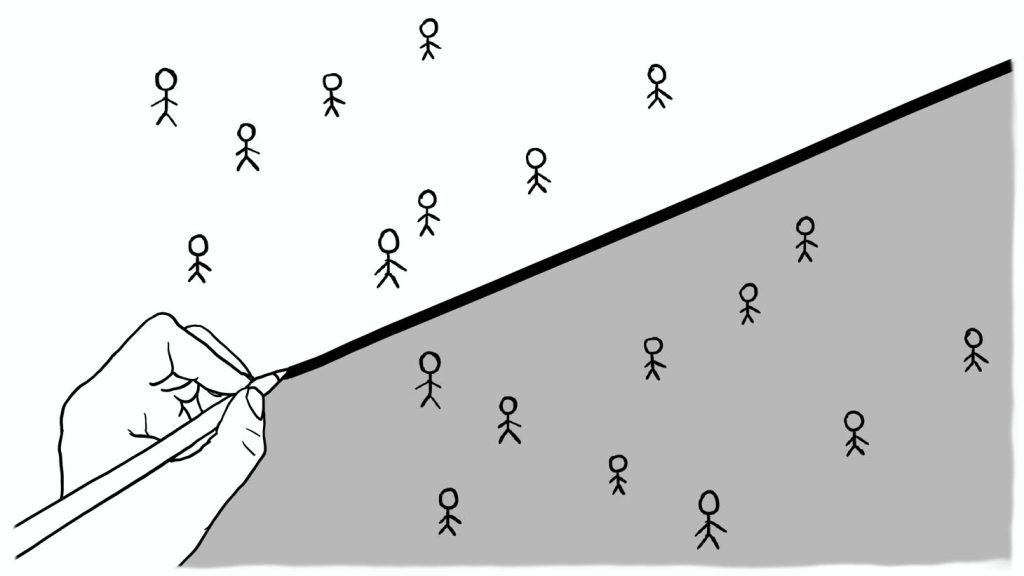
Most of us would bristle at any proximity to the label “dehumanization” – that’s what happens in genocides, hate movements, and the ugliest chapters of history. It’s something extreme people do. It isn’t something we do.
But John Paul Lederach, one of the world’s foremost practitioners of conflict transformation, would gently push back on that assumption. After nearly five decades working in some of the most violent and protracted conflicts on the planet (ethnic, religious, cross-cultural, and political in nature), he’s come to a striking conclusion: dehumanization doesn’t announce itself. It hides in the most ordinary corners of our lives.
Social groupings are a normal thing. When you’re part of a group, you have a certain identity which distinguishes you from other groups. We locate who we are by comparing ourselves with others. Much of this has a natural quality to it, but there comes a point at which polarization – that identity tied to a group – becomes toxic.
A key sign that natural grouping is shifting towards toxicity, is the slow descent into dehumanization; in other words, into humiliation: othering in a form that negates and invisibilizes the shared humanity of other people across our relationships and across this globe.
This dehumanization happens in a slippery, often unnoticed way – even as we participate in it. We tend to recognize it only if we see it in its most extreme forms, when it’s labelled racism, sexism, or the ilk that negates the very notion that the “other” is a fellow human being.
One of the clearest early signals that conflict is intensifying is a shift in language. Conversations that once dealt in specifics – this person, this situation, this harm – begin to shift into generalities. The particular dissolves into the categorical, the pronouns becoming “we” and “they”.
It sounds almost too simple to matter. But pay attention the next time you’re in the middle of a difficult disagreement – at work, in a family, in a neighbourhood dispute, or in a conversation about local politics. Notice how quickly the language slides from "I experienced this" to "they always do that." Notice how a whole group of people gets compressed into a single, undifferentiated “them”.
This shift towards generalization is where dehumanization quietly begins. Not with hatred, necessarily. Often just with fatigue, or frustration, or the very human need to make a complicated situation feel simpler. But the effect is the same: real people, with real complexity, get flattened into a category. And categories are much easier to dismiss, to blame, and eventually to harm.
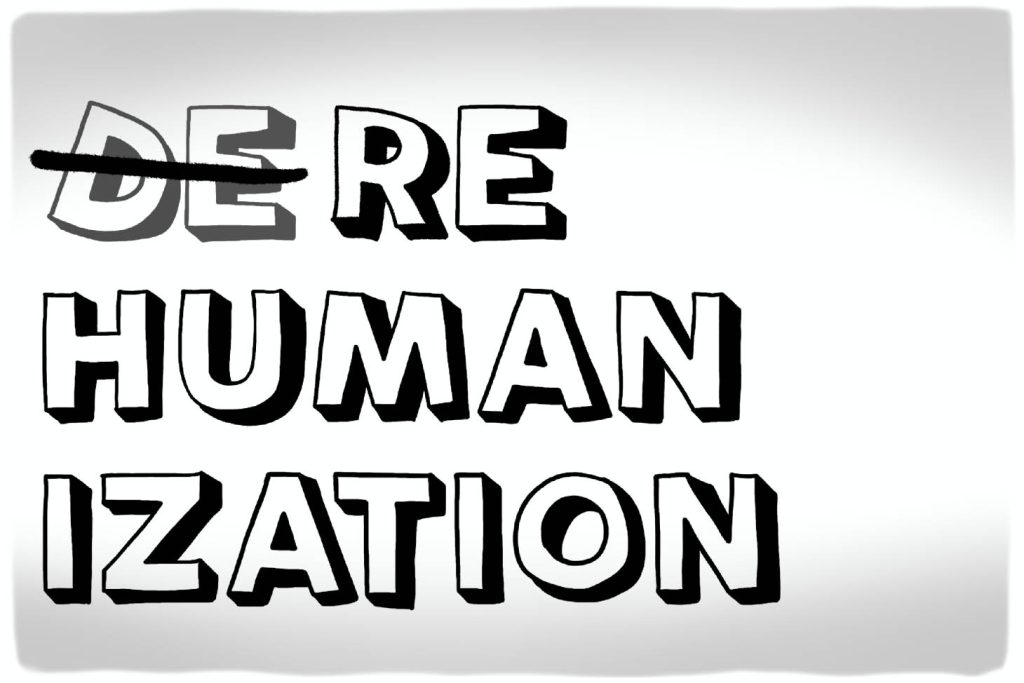
Here’s something worth sitting with. Our dictionaries have an entry for dehumanization. We have research on it, language for it, and whole fields of study devoted to understanding how it happens. But most dictionaries have no entry for rehumanization – the process of finding our way back.
There is a gap here. We’ve become fluent in describing the descent. We haven’t developed nearly the same vocabulary – or the same imagination – for the return.
This asymmetry matters, because it shapes what we pay attention to. If dehumanization only counts when it reaches its most extreme and recognizable form – overt racism, targeted violence, systematic oppression – then we miss everything that leads there. We miss the slow drift, we miss ourselves in it, and we miss the opportunity to course-correct before things escalate further.
Rehumanization is the act of restoring human qualities to others. The work begins where we have access – in the conversations we’re actually part of, with the people we’re actually connected to.
That means noticing when our own language is drifting toward the categorical. It means asking, when we find ourselves thinking in terms of “those” people: who, specifically? What do I actually know about them? What am I assuming?
It means, in short, practicing a kind of deliberate particularity – refusing to let conflict flatten the people around us into symbols of whatever we’re afraid of or angry about. Instead, it means bringing compassion, patience, and humility to the conversation. These qualities aren’t reserved for diplomats (or even professional mediators).
None of this is easy. But the small, quiet work of rehumanizing others in our minds and in our language is not incidental to peacemaking. It is peacemaking – available to all of us, starting right now.
We have several more blog articles on peacemaking planned for publication in the coming months. This is just the start – stay tuned.