Looking Closer: Why do good people develop bad habits?

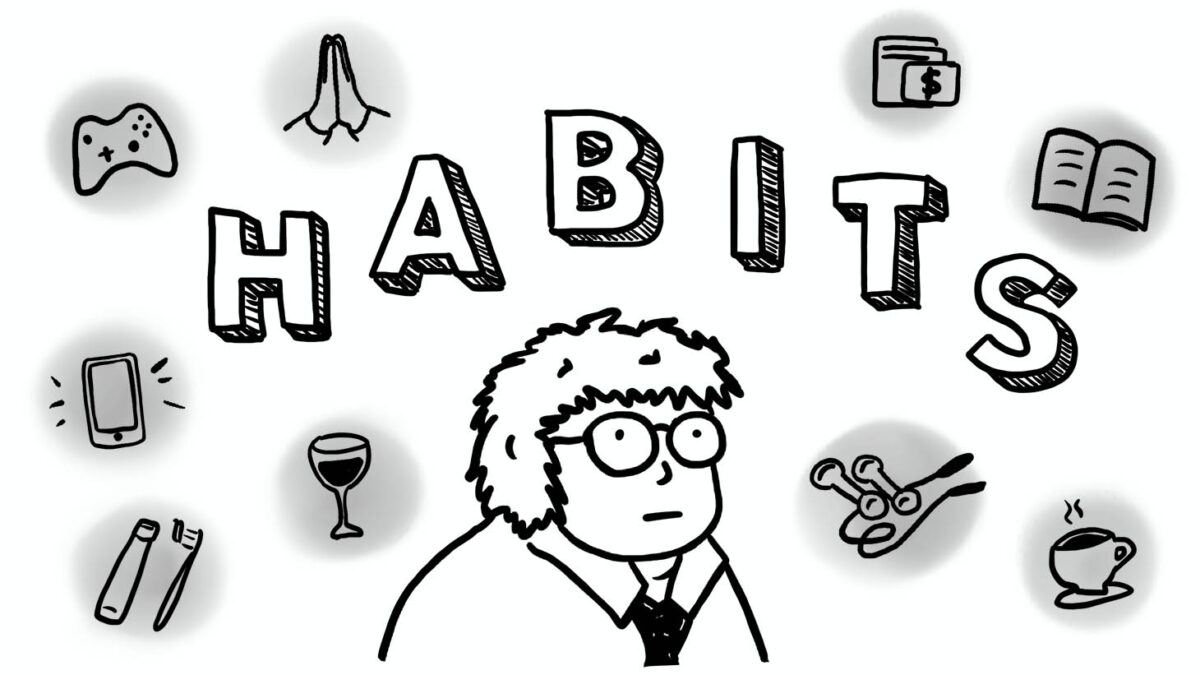
A person sits under a banner reading HABITS with floating habit examples around him

Most of us like to think of ourselves as good people. Yet, if we’re being fully honest, most of us will also admit to having a bad habit or three.

It begs the question: why do good people develop bad habits?

With repetition, particular behaviours become ingrained. The neurological pathway followed from stimulation to reaction becomes more entrenched each time we act in that certain way, making it difficult to react creatively. As Donald Hebb, the father of neuropsychology, came to realize: neurons that fire together, wire together.

These optimizations can be beneficial or detrimental – but before we qualify any action into a category, let’s take a step back and look at the basics of how a habit is formed.

Habits consist of four components that create a neurological loop: cue, craving, response, and reward:

  1. Cue: A cue is a trigger that initiates the habit loop. It can be internal (a feeling, thought, or emotion) or external (a time of day, location, or the presence of other people). Cues serve as reminders to engage in a particular behaviour. For example, feeling stressed might be a cue to reach for a cigarette, or the sight of your running shoes might prompt you to go for a jog.
  2. Craving: Once a cue is encountered, it triggers a craving for the associated reward. Cravings are the motivational force behind habits, driving us to act in a way that satisfies our desires. They can be driven by various factors, such as seeking pleasure, avoiding pain, or fulfilling a need for social connection. The intensity of cravings can vary depending on factors like hunger, stress, and environment.
  3. Response: The response is the actual behaviour that is performed to satisfy the craving. It can be a physical action (such as eating a snack) or a mental process (like engaging in negative self-talk). Responses become habits when they are repeated consistently to specific cues.
  4. Reward: The reward is a payoff that reinforces the habit loop. It provides positive reinforcement, making the behaviour more likely to be repeated in the future. Rewards can be intrinsic (a sense of accomplishment or satisfaction) or extrinsic (praise from others or a monetary incentive). The reward serves to strengthen the connection between the cue and the response, making the habit increasingly automatic.

The cue triggers a craving, which leads to a response, and ultimately results in a reward. This loop becomes ingrained in our brains with each repetition, reinforcing the habit. While this can be helpful for behaviours we want to keep, it also makes it difficult for habits we want to break.

Bad habits tend to feel good in the short-term, with any troublesome consequences delayed until some later time. Not cleaning your bedroom, for example, feels like a good choice in the moment. Long-term however…the mess remains and we might not be loving that choice down the road. Despite this, the rewarding initial feedback reinforces the habit loop and so we choose it again and again.

Good habits, on the other hand, often require immediate effort with rewards that only become apparent over time.

The habit loop in arrows - cue to craving to response to reward (and back to cue)

The bad news is we all have bad habits, but the good news is that the habit loop can also be leveraged to our advantage by adjusting its different components.

If we want to start exercising regularly, for example, you might identify a cue (waking up in the morning), create a craving (visualizing the benefits of exercise), make the response easy (laying out your workout clothes the night before), and provide a reward (treating yourself to a healthy breakfast after your workout).

By manipulating the habit loop’s components, we can effectively change behaviour and intentionally create new, positive habits – or, replace existing ones.

How might we use the habit loop to address the way we handle conflict? Dive deeper into precisely this application in part two of this exploration: Looking Closer: Habits in the face of conflict.


If you’re already ready to address your habits around conflict, then check out our free webinar Conflict 101: Demystifying Conflict Through a Psychological Approach. We also encourage you to take a look at our current online and in-person programming to explore other options.

Deeply ingrained habits can be hard to change, but it’s not impossible. We can do hard things. We can start now.

Commitment: The key to realizing the fruits of our labour.

Details of apples laid out like a classic wallpaper

The key to realizing the fruits of our labour is commitment.

This isn’t just a catchy and appetizing phrase. We literally want you to think about fruit.

Consider this:

You’ve just finished a delicious apple and are holding its seedy core dreaming of a fresh one. There isn’t a supermarket around (adding that detail for the snarky reader in the back), so you decide that it’s a good idea to grow your own. This way, apples will be plentiful going forward.

But an apple tree isn’t grown in a day.

First, the seed needs to be coaxed to sprout – in a sheltered environment where you can ensure the moisture and lighting conditions are not-too-much and not-too-little. After a time, you expose the seedling to the elements – at first for just a few hours, so that it can get used to wind and weather. Eventually, hardened and ready, you plant it in a place that is suitable for both today and decades from now. You continue to water it for the season.

But it doesn’t stop there. As the years go by, you sustain the effort of nurturing the tree: protecting it from the foraging munch of animals, wrapping it in burlap to shield it from winter’s frigid bite, and watering it in seasons of threatening drought.

If all goes well, after seven years that little seed will finally be producing fruit. Well established, it no longer requires much effort from you at all. And after all the hard work, you can finally sit back and enjoy that apple you dreamed of so long ago – literally enjoying the fruits of your labour.

The takeaway? A tree is not grown in a day and it takes consistent effort to get it to bear fruit. That, and we should never take what’s readily available at the supermarket for granted.


What does tending a garden have to do with conflict? Well, yard work is not the only hard work that takes time to realize the fruits of our labour. So too it goes with learning anything new.

In conflict resolution, a tough situation is usually what spurs us to begin looking closer at it, and so we come to it from a place of deep need. We want quick results – which might be possible in terms of addressing acute issues with a third-party mediator – but are less realistic in terms of actually changing the deep-seated habits at play.

Just like planting a seed and walking away is not enough to sustain the potential tree within it, the process of growth within ourselves takes time to integrate with our lives.

A chalkboard with the written exclamation: Commitment over motivation

Motivation is what often brings us to explore conflict resolution, but it is commitment that helps us stay the course.

It’s easy to be motivated when we’re focused and inspired, but the unexpected hiccups in the complicated real-world can pose a challenge:

There’s no getting around the fact that achieving lasting change is difficult. If we’re focused solely on an outcome in these frustrating situations, motivation wanes and leaves us feeling discouraged. That’s why it is important to emphasize commitment as a driving force instead.


Commitment is more important than motivation. So many times we need to learn the hard way – despite our best efforts. When this happens we need to keep going. As much as we love the energy that motivation brings in driving us forward, waiting for it can hold us back. On the other hand, commitment involves dedication to the process rather than a desired outcome and does not waver when motivation ebbs.

We might not always want to get up early to water the apple tree, but commitment to the process is what prevents us from hitting the snooze button. So too with facing the discomfort of conflict in our lives.


Not sure where to begin? We’ve got a free webinar for just that: Conflict 101: Demystifying Conflict Through a Psychological Approach is the perfect place to start.

Looking for a particular seed to water? Browse our current online and offline training programs to explore ideas that will support you at home, work, and in your community.

Despite the hurdles of learning something new, over time we can look back and see results trending in the positive direction we’re aiming. Let this encourage you to remain committed to the long-term benefits of the process – where we can overcome initial challenges, walk the longer path, and reap fruitful rewards from our efforts.

Conflict Strategies: The time-out approach.

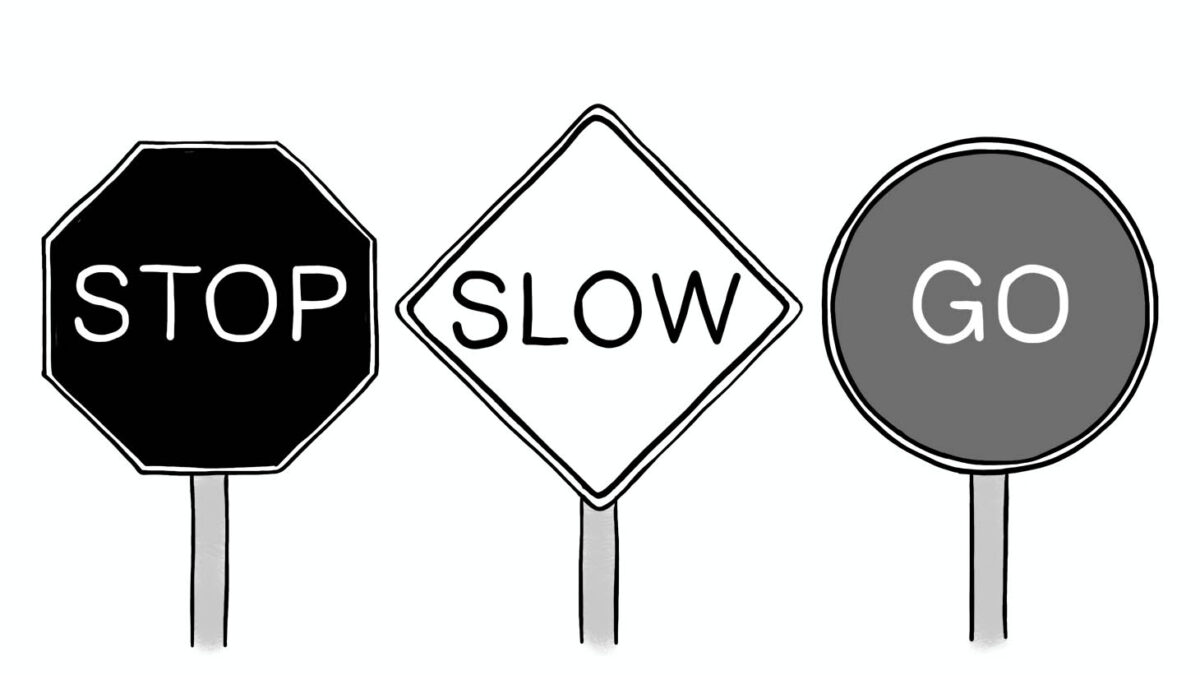
Three street signs: Stop, Slow, and Go

Sometimes the best strategy to deal with conflict is to say, “I’ll deal with it later.”

Does this sound…surprising to you? Often we think to ourselves: the best way to deal with conflict is head-on. The unspoken second part of this belief is that avoiding a tough situation only makes things worse. It’s important to note however, that this is only true if we never actually come back to face it.

Taking a time-out can be a valuable strategy to promote effective conflict resolution. Vocalizing unfiltered hot takes can get us into trouble – something we only realize once we have some time to cool down. In the face of conflict a defensive impulse kicks in at the biological level, takes over, and creates a mess that then needs to be cleaned up.

Alas, it’s not as easy as having your mediation coach blow the whistle and pull you off the field. Inevitably, we sometimes wish there was an undo button for something we shouldn’t have said – though, even if we delete that fiery social media exclamation we shouldn’t have posted, everyone who saw it is still impacted. Actions cascade outward like ripples from a stone tossed into still water. And like the proverbial rock, once it is loosed an action is out of our hands and the resultant ripples out of our control.

The only path we have is forward. If we make a mess handling conflict unwisely (and we all will), then it becomes our responsibility to clean it up. Conflict will happen again – a frustrating fact that on the positive side means we have opportunities to practice our engagement with conflict. With a bit of consistent effort and resultant restraint, we can learn to mitigate escalation.

A robot talking into a phone saying: Can we reschedule our meeting? I'm about to blow a gasket.

There is no absolute rule as to when is the best time to deal with conflict.

In the heat of the moment, it’s easy to forget this and instead feel the pressure to respond immediately. We get caught up in the back-and-forth rhythm of the interaction – trading defensive blows rather than listening. After all, we are obviously the one in the “right” and just need a moment to retort our truth. The problem is, the other person also thinks they’re in the “right” and…well, this doesn’t usually add up to a peaceful understanding.

When we’re waiting to clap back at someone else’s “wrong” position, we’re in a headspace where we’ve stopped listening to what they’re saying. Instead, our internal monologue is busy rehearsing a witty response while we keenly watch for a chance to speak it loud and true. Amidst differing perspectives, this creates a divisive and competitive atmosphere that is not conducive to conflict resolution.

The next time you find yourself in a conflict, consider using a time-out approach. Politely express your need for reflection and understanding by saying something like:

There’s some new information here that I’d like to consider. Is there any chance you can give me some time to reflect on it, and I can come back to discuss this later this afternoon?

Taking a momentary step back allows you to escape the immediate emotional charge of conflict. It creates a space where you can calmly analyze the situation from a zoomed-out perspective, gaining insight into both sides of the conflict. This reflective time can help you better understand your contributions to the conflict and discover healthier ways to respond with respectful curiosity.

By engaging in self-reflection and considering the conflict from a calmer standpoint, you equip yourself with the tools needed to respond thoughtfully and constructively. This approach fosters empathy, promotes understanding, and enhances the chances of finding mutually beneficial resolutions.


At Mediation Services, the tools and strategies we explore in-person and online help us be ready to respond with to conflict with agility. But the consistent heart of our process-oriented approach is to remember to always approach conflict with empathy, respect, and a genuine desire for resolution. These pillars permeate the process and help us shift from judgment to curiosity.

Curious to learn more? Check out our FREE online webinar Conflict 101: Demystifying Conflict Through a Psychological Approach.

Together we can foster resolution to build stronger and more meaningful relationships. Now is a great time to start.

Breaking It Down: Different types of conflict.

A cluster of diverse question mark speech bubbles overlapping each other

A question for you: How many different types of conflict do you think there are?

It may sound like a riddle, but let’s take a moment and give it some thought.

Is there only one type of conflict? No, the messiness of lived experience tells us that it’s more complicated than that. So are there infinite flavours of conflict because every situation is entirely unique? That feels a bit more accurate, but there also seems to be repeating patterns in the myriad of ways it plays out.

Organizing conflict in any sort of clear way is difficult when we’re in it, no matter how much experience we have. But from a zoomed-out perspective, we can begin to see the commonalities at play.

It’s important to note that conflict is a natural part of human interaction. It’s not good or bad in itself, but simply a part of living in community that needs to be worked with.

Understanding the different types of conflict can help us navigate them effectively. By recognizing their characteristics, we can develop strategies to address them constructively.


Though a simplification, it’s useful to start with the assumption that there are only two types of conflict.

Conflict Type #1: Missed Expectations

Missed expectations occur when someone does something that goes against what we expected them to do or fails to meet our expectations. This type of conflict involves unmet or violated agreements. By understanding the dynamics of missed expectations, we can approach them in a way that fosters understanding and resolution – hopefully avoiding the pitfall that is the attribution problem.

In cases of missed expectations, it’s always best to lead with questions of curiosity, such as: what was going on for you when this happened? Tell me a little bit more about the situation. What caused this expectation of mine not to be met?

Very often we will find that there was some rationale for why things unfolded the way they unfolded. And the person who is being asked these questions will likely make the connection that what happened didn’t work for you. And if that’s the case, if we have a healthy relationship and the person wants to make amends, that gives them a space to let them know that they didn’t intend to cause harm. And if they did cause harm, they’re likely going to want to make it right.

Conflict Type #2: Disagreements

Disagreements arise when individuals have differing opinions, beliefs, or preferences. Although disagreements may not involve violated agreements, they can still lead to tensions and conflicts. Understanding the nature of disagreements allows us to engage in productive dialogue and explore potential resolutions.

Disagreement doesn’t necessarily equate with conflict. Consider this example: You want to go to a restaurant with two of your work colleagues, but you don’t agree on what type of restaurant to visit. At some point, if you don’t come to a solution you’re going to get hungry. And a few minutes later, you might start to get hangry! At this point the disagreement has the potential to become conflict (relatable, right?).

Solutions to disagreements aren’t as straightforward as those to missed expectations, but the process remains the same: always aim to shift judgement to curiosity.

A conversation grounded in curiosity might sound like this:

I see your point and I understand how your position allows you to meet the needs for X, Y and Z. And I also think that A, B, and C (i.e. my needs) are also important. And I’m not sure how your position might address these things that I think are important. Could you let me know a little bit about your position and how it might be able to meet these needs if I’m missing something? Or do you think there is space for your position to be shifted a little bit so that we can prioritize my needs as well?

By staying grounded in an attitude of curiosity, we open up the potential for landing on a solution. There are four types of solutions we can arrive at:

  1. Shift in position (okay, you convinced me to get a burger for lunch instead of pizza)
  2. Compromise (since we can’t agree on a restaurant, let’s go to a food court where we can all get what we want)
  3. Separate (respecting each of our different needs, let’s go our separate ways for lunch today)
  4. Shift from consensus-based decision-making to majority-rule decision-making (let’s vote on it and decide that way)

You won’t necessarily know what solution you’re aiming for when you start managing this type of conflict, which is why you should instead focus on the process of curious and respectful conversation. Eventually, the right solution will present itself to you and the others involved.

A wild rollercoaster with different emotional emojis along it

So, how many types of conflict are there? The answer is that it depends on the framework that you look upon it from.

At Mediation Services, we ground the conflict resolution process in the perspective that there are two types of conflict. From this understanding, we build a framework to address tough relational situations that otherwise feel like an up-and-down rollercoaster of emotions.

And how can you establish this for yourself? Well, that’s a question we do have a clear answer for. Our FREE on-demand Conflict 101 webinar is an opportunity for anyone (like you!) to begin unpacking what conflict is and how it’s playing out in your life.

We also invite you to attend our in-person trainings that we offer here in Winnipeg or, for your convenience, our expanding online collection of webinars that embrace accessibility, flexibility, and getting to learn at your own pace.

If you need deeper support for a specific situation, head over to our mediation self-referral page and fill out an intake form for neighbourhood/community conflict, family conflict, or workplace conflict. We can serve as an experienced third-party and facilitate a mediation session to help generate an understanding of everyone’s issues and concerns – and, importantly, to work towards an agreement.

Navigating conflict is a complicated process for which there is no one-size-fits-all solution – but don’t be daunted! The most important thing is to start unpacking conflict more consciously.

It takes time to integrate these tools into one’s life and its relationships, but the effort pays off in dividends. Start today!

Getting Clear: The true cost of free.

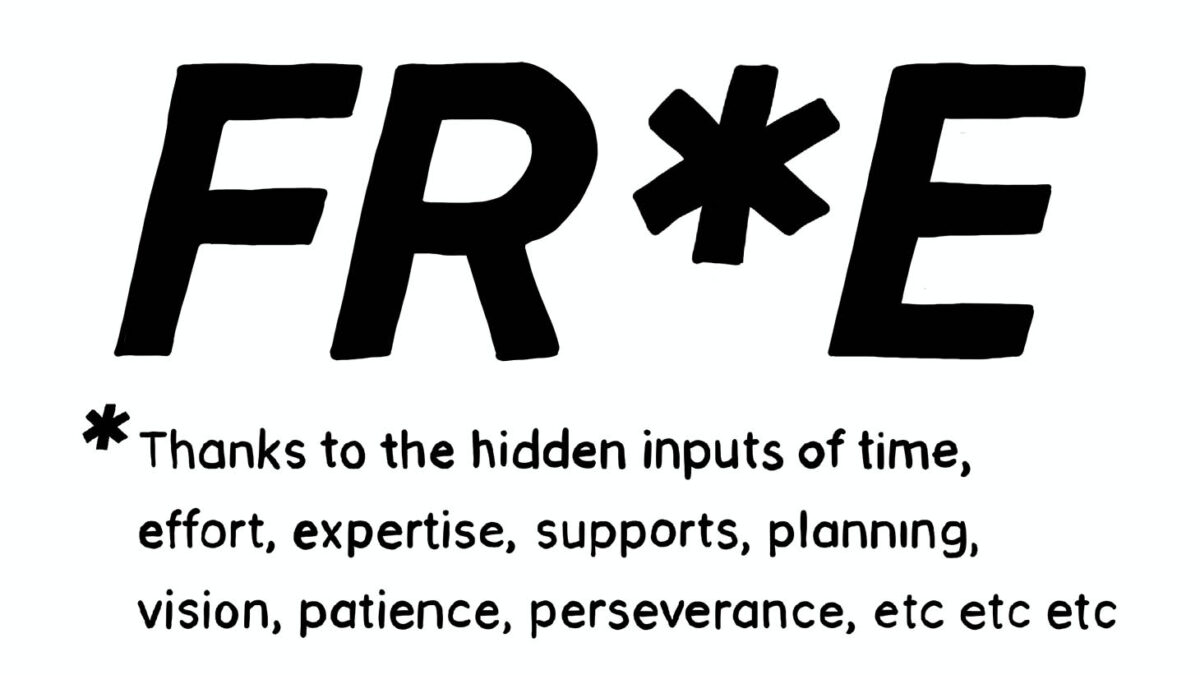
FREE in large lettering with an asterisk and fine print

An old adage goes: there is no such thing as a free lunch.

Free lunch, in this case, refers to the once-common tradition of saloons in the United States providing a “free” meal to patrons who had purchased at least one drink – an important asterisk attached to the word “free” to make sure costs are covered and the business stays viable and successful.

As with many classic sayings, it now gets taken beyond the original context of hospitality industry economics and applied in a myriad of different ways – from the scientific law of conservation of energy to the business strategy of free internet services. Nonetheless, the gist of this economic proverb is that the word “free” always comes with an asterisk because everything is the result of many other unseen things that went into it.

When it comes to meals, a free lunch may be served but it still costs someone else something to produce, harvest, package, transport, prepare, distribute, and clean up after. Even if money is not exchanged, immaterial currency such as time, labour, resources, and individual skill are invested.

In the end, all of these inputs need to balance the outputs for something to stay sustainable.


Here at Mediation Services, we are no exception. When we put something out for free, it is only possible because of the many resources bolstering it behind the scenes.

For example, take the Conflict 101 webinar that we recently released. It required practical logistics: rent, electricity, and the wide task of organization. Then, there was the equipment: it required gear in the form of lights, camera, ACTION (that last one probably should read microphone but action fits too perfectly)! Anchoring the project, there was the presentation time and talent of an expert (with years of study and experience in conflict resolution behind them). After filming was wrapped, the tedious minutiae of editing began. The footage had to be reviewed – video edits matching the iterating manual that went alongside it until a final product was funnelled through the internet to many personal computers. Oh, and let’s not forget childcare – viral videos with little ones interrupting something serious are only cute the first time.

Clearly, a lot goes into developing a webinar – even when, in this case, it is offered for free. All of these pieces need to be puzzled together to ultimately make it happen.

If you’re feeling any tinge of guilt for accessing our free resources – don’t! Use them, and use them well; that’s what we happily created them for. Our intention in highlighting the behind-the-scenes details is our way of expressing pride in all the hard work that went into creating these offerings. We are excited and grateful to have a web of support that makes what we do possible.

Puzzle pieces with different resources listed on each

It’s worth taking a moment to appreciate this. Hidden within everything offered are the many inputs that brought it to fruition. The prerequisites of effort and generosity are the bare minimum to create something that is given freely. Beyond the dollar amount is the true cost.

At Mediation Services, we couldn’t do the work we do without the financial support of private donors, local governments (the Province of Manitoba and City of Winnipeg), and community organizations (like The Winnipeg Foundation and United Way Winnipeg). We are grateful for their support and trust in us.

Finances are just one piece of the puzzle; our services wouldn’t be possible without the daily commitment of our office staff and volunteers. These folks bring the knowledge, dedication, and potential that frankly is hard to put a price tag on.

Take a look at our 2023 year in review, where we reflect on the novel things we were able to accomplish (in addition to the community services that have been our core for decades). This is a glimpse into what the pieces add up to.


Mediation Services is a small organization that aims to have an outsized footprint, facilitating peaceful interactions that transform relationships. We are passionate about what we do and we couldn’t do it without you.

You can support us in a variety of ways:

  • Enroll in an on-demand webinar: These resources are available at your fingertips instantaneously and are priced anywhere from free to fair (in our humble opinion). Check out the full offerings here!
  • Spread the word: Tell someone about our conflict engagement training opportunities or register yourself for our skills-based learning (see details here for current online or in-person options).
  • Monetary: We need your financial support to add stability to our funding model. Please consider making a monthly donation to further our work in peace-building and restorative justice. You can donate online through our Canada Helps page or send an e-transfer directly to bookkeeper@mswpg.ca. Mediation Services is a registered charity and tax receipts will be issued.

As we look to the coming year, we believe it is important to get clear about the true cost of things.

Your support today can help strengthen our community tomorrow. Thank you for being a part of the work we do.

2023: A year in review at Mediation Services.

Image of a hand writing the date with a pen, crossing out 2023 in the date to update it to 2024

It’s that time again – where the first penned date of the new year involves a crossed-out 2023 (yet another case of the sometimes-annoying biological automations our wondrous brains are capable of).

Time flies, and it’s hard to keep up.

Although yesterday is not so different from today, the flipping of the calendar is an opportunity to pause, reflect, and take stock of all that has happened.

Here at Mediation Services, this past year was one where we continued to take steps forward from the Covid pause. In-person offerings ramped back up to full steam – and , in many cases, have been levelled up. Online, our programming continues to expand – offering more resources than we’ve ever been able to before, and at a new level of accessibility in terms of affordability, timing, and ability.


And so without further ado, here is our 2023 year in review:

And there’s more where that came from. On all of these fronts, there is an encouraging momentum carrying us forward. We’re excited by the potential future at our fingertips and look forward to sharing it with you.

See you next year!

Sincerely,
The whole team at Mediation Services

Schemas: Making sense of our biological automations.

Two humans dressed up as robots, saying "Beep Boop Beep" to each other with funny looks on their faces.

Ah, biology! Perhaps it is most intimately known in our awkward high school years where we came face-to-face with it in lab dissections…and puberty. But the embodied principles of ATP synthesis and mitochondria don’t stop there. In plain English, we learned that we are what we eat; transforming nutrients into useful things in our bodies. And in life outside the classroom, we learned what to eat to provide fuel for our growth.

Now, do you think about this digestive process when you eat something? No – because our bodies have evolved to do this unconsciously.

So too it is with other things we consume: experiences are processed and shape both our minds and bodies alike. And similarly, the internal optimizations of the brain happen without us knowing. Much like in high school biology class, it’s worth shining a light on this so we can better understand when this process is serving us well and…not so well.


Our experiences establish our unique personal schemas: mental frameworks or structures that exist in our minds to help us organize, interpret, and make sense of the world around us. Schemas can be thought of as lenses that filter the stimuli coming through to our senses. As a result, our responses to experiences can become quicker, even automatic.

Are automatic reactions bad? Well, unfettered defensiveness can certainly make situations messier. And we’ve all had experiences where our emotions get the better of us.

But are all automations bad?

In any given moment, a lot of information is coming at us. If we had to think about everything, it would be completely overwhelming.

Consider a Friday luncheon with your colleague. If you had to think about each detail intimately, lunch would not be a very enjoyable experience:

Squeeze fingers around fork. Lift fork. Stab slippery salad greens with fork three times until efforts are rewarded. Lift fork to mouth. Open mouth. Put fork in mouth. Close mouth and remove fork. Chew chew chew…on and on, masticating on each necessary detail.

Yet somehow, we can manage to carry on a conversation with our mouths full – while tuning out the lesser details so that we can focus. We lift the fork to our lips and enjoy tasty sustenance with grace.

Another day, another luncheon. Sitting next to a toddler who is painstakingly lifting one pea at a time to her mouth (and occasionally throwing one to the floor), we bear witness to how the unconscious automations we take for granted are trained and developed. Over the years, the action of feeding herself will become refined (hopefully), so that she can enjoy a meal and a conversation without accidentally biting her fork or flicking food off her plate (ideally).

Automations can, indeed, be rather useful.

Dominoes fall against each other

Schemas and their resulting automations show up not just as physical manifestations, but also social ones. From the dynamics of the family nest and the playground, we step out into the workplace and the world; past interactions building our unique schemas from which our reactions flow. Informed by experience, each of our mental maps develop differently. And, it turns out, the resultant viewpoints on what is acceptable behaviour do not always match up.

So consider this: how might this process of pre-cognitive awareness, meaning-making, and automatic response play out in the face of conflict?

When we apply these automations to situations of conflict, we lose the ability to respond to that-which-we-face objectively because we become robotic. We may feel completely in control of our thinking and actions, but the reality is that we have subconscious internal domino effects where one trigger covertly leads to another – which lends a risky element to their existence. Though we think that our reaction is happening because we’re choosing it, it is instead an automatic process based on the past that is very mechanical.


Can you think of a reflexive habit that is causing problems in your relationships? Don’t worry – we all have them. Rather than push them away, we can work with our biology.

Learn more about schemas as lenses and automations in our free online webinar, Conflict 101: Demystifying Conflict Through a Psychological Approach. In it, we dive deeper into these concepts and how to improve our schemas.

We can make big changes – one small step at a time.

Schemas: The lenses through which we see the world.

Nonsensical numbers with an alert indicating scanning

Have you ever been told, "You sure see the world through rose-tinted glasses"? Or, perhaps not – as there’s this persnickety little tendency we humans have which is called the negativity bias. Whether your worldview is rosy, sepia, or black-and-white, this colloquial saying highlights the very real idea that how we see the world affects our reality.

What we see (or hear or smell) gives us a gut feeling – a sense of ease or alarm. This informs how we perceive the situation and, naturally, any actions that follow.

Is a dog smiling at us with both its mouth and eyes? Then we’re inclined to approach and offer him a scratch behind the ears. We smile back and murmur, "Good boy, a very good boy, who’s a good boy," to anyone within earshot.

Is a dog watching us with bared teeth and slanted eyes? We shy away, and with tense shoulders gauge how strong the fence is between it and us. Our hands stay stuffed in our pockets. No pets for that one.

This sort of pre-thought perception is a survival mechanism in a world where a lot is coming at us – it helps us react quickly when we need to. But here’s the rub: just because we have a gut feeling doesn’t mean it’s always right.

In the face of conflict, it gets more complicated. Gut feelings bubble up in the heat of the moment, and emotions fuel actions instead of thought. If our perspective is off even a little bit, then things can unnecessarily escalate.


So how do we manage these gut feelings? Where do they even come from?

Our sense organs provide our window out to the world. Sight, smell, sound, touch, and taste…each stimulus is sent as information to our brain, which makes sense of all this input.

Since we are constantly being bombarded by stimuli, we have evolved to build mental maps so that we are less overwhelmed. In psychology, these are known as schemas: mental frameworks or structures that exist in our minds to help us organize, interpret, and make sense of the world around us. In life, this translates to the biological superpower of automatically seeing something, categorizing it, and reacting. Everything we perceive is filtered through these mental maps. But no map is ever perfect.

Looking through eyeglasses with a friendly dog on the left side and an aggressive dog on the right side

When we encounter something new, our schemas instantly come into play, influencing how we interpret and make sense of the information presented to us. These mental lenses filter and organize our perceptions, enabling us to categorize and anticipate the behaviour of others. Schemas help us navigate social interactions by providing a set of expectations and assumptions about how people should behave in different situations. They streamline our cognitive processes, allowing us to make quick judgments and responses based on past experiences and learned patterns.

To quote Anaïs Nin, who put it quite succinctly:

We don’t see things as they are, we see things as we are.

Or, to use the language we’re unpacking here:

We don’t see things as they are, we see them as our schemas see them.

Schemas are hard to notice, in and of themselves. Rather, we experience their manifestations through the automatic thoughts and responses that they result in. Some lenses work well for us, and others…less so. Any distortions in our schemas also show up in our perceptions.

We all have our blind spots which, as their name implies, are unconscious. Maybe it manifests as a discriminative categorization of people by gender, race, or whatever. Or maybe it’s details that we add in to make sense of a situation. These blind spots can warp our perception of reality. Fortunately, it doesn’t have to stay this way: with a bit of courage and determination, we can refine our schemas.

The next time a conflict arises in your life, it’s worth taking a moment to consider how a schema might affect your perception of the situation. Why might you feel that way? Is your feeling valid? What is the other person feeling right now?

A bit of curiosity goes a long way in unpacking what’s playing out in our lives. Over time these situations become opportunities to refine the lenses through which we see the world, ultimately changing our responses into more fruitful acts. Conflict is natural and doesn’t need to be a bad thing.


While a gut feeling is something to be listened to, it’s important to remember that it’s not everything. When you notice a strong reaction arising from within, can you replace the feeling of knowing or judgment with curiosity? The practice of returning to an attitude of beginner’s mind is helpful – even if it takes time to make a habit out of it, it’s worth the effort.

Want to unpack this more? Check out our free online webinar: Conflict 101: Demystifying Conflict Through a Psychological Approach. In it, we dive deeper into this concept of schemas and challenge our automatic responses that arise from within. Through study and daily practices, this introductory course presents an opportunity to improve both our relationship with conflict and the communities in which we live our lives. Start today here.

Flipping Assumptions: Innocent until proven guilty, or not?

Cartoon-ish fingers point in circles at each other

When an uncomfortable interaction with someone else riles us up, it is natural to want to make sense of it. Why would someone act that way? Because they are mean! Cruel! Unreasonable! Arghhhh!!! We quietly scream this familiar internal refrain, and – uh oh – there it is, the pesky attribution problem once again. We jump to conclusions about a person’s character without considering the circumstances behind their irksome behaviour.

This way of thinking is less than ideal, as it leaves no room for reason. The judgment establishes itself without a logical line of thought, driven by emotions to a negative read on the situation. This cascades into escalation, impaired communication, bias and inflexibility…culminating in long-term consequences that get increasingly difficult to untangle.

Fortunately, with persistence and a healthy dose of hope, we find that approaching our antagonist can help us understand their perspective. With an attitude of curiosity, listening to their side of the story can help us soften our hardened stance.

That said, an open conversation isn’t always possible. In some circumstances, the other person might have left the picture or become unapproachable, in some way or another. Alone with our thoughts, how do we make sense of the situation in the best way possible?


When was the last time you had an uncomfortable interaction? Did it replay in your head afterwards – for hours, days, even weeks? With each replaying of the moment, how did it feel? Did your idea of what happened become immutable?

When our emotions intertwine with a sense of defensiveness, projecting guilt outward is usually the result. Placing blame on others can be a way to make meaning of an uncomfortable situation. Sometimes this may be accurate, but a lot of times it turns out to be a bit more complicated than that. So if we are going to be conjuring scenarios in our heads to try and explain why someone did what they did, why not try and put a positive spin on it?

A helpful way to flip the assumption of guilt to a consideration of innocence is to ask yourself the following when frustrated with another person in conflict:

What would make a good person do what they did?

Perhaps stress from another aspect of their life was distracting them. Or maybe pressure from time constraints didn’t allow them to show up as their best self. Maybe they had a bad night’s sleep. Maybe they just received some bad news.

Whether this generous allowance is true or not, it is an approach that tempers the biological defensive response that can otherwise take over. As a result, we shift from problematic escalation that arises from negative assumptions to approaching conflicts with openness and a willingness to engage in dialogue – dealing with what’s present rather than an idea in our heads.

A person with thought bubbles showing the consideration of replay, rewind, and fast forward

We don’t exactly have clear rules to indicate what’s normal for people to act in everyday life decisions. Instead of having traffic signs dictating the speed at which we should live, we have things like culture and personal identity as our guideposts.

We also have preferences, we have styles, we have strengths, we have weaknesses…all of which are our speed limit and speed maximum signs – and they’re different for everyone. We all have different perspectives, and how we act or react to something varies greatly for each of us (much like the idea that respect is in the eye of the beholder).

Most importantly, we have the capacity for choice. We can move through life by being judgmental of everyone and assuming guilt…but is that the type of world that we want to live in? Instead, we can live in a world with compassion and empathy – choosing to replace that judgment with curiosity.

What would make a good person do what they did? When flipping the attribution problem on its head with this question, remember that life choices are complex and nuanced. All of us would like to be treated as innocent until proven guilty.

Try to catch moments where you’re ascribing meaning to someone else’s character rather than their circumstances. Extend the openness that you wish others would grant to you. This is how we set examples for each other in establishing a more positive default in our communities and culture.


In a sense, our advice today is as simple as the age-old saying treat others as you would like to be treated. But as it often goes, the simplest things are not always the easiest ones. And while imagining circumstances in a positive light is a useful strategy, it’s still less than ideal on its own. Having open dialogue is always the primary goal. But, as another age-old saying says, it’s easier said than done.

That’s why we are here to help: check out our free Conflict 101: Demystifying Conflict Through a Psychological Approach webinar). Learn about how to resolve conflict, whether or not the other party is present. With the right tools and persistent practice, we can cultivate deeper, more rewarding relationships that enrich every aspect of our lives.

Read a brief outline for the Conflict 101 course here and enrol today.

Reason and Reasonability: Embracing emotions as a superpower.

A human in a cape flies over cityscape

Do you remember the last time you were angry? Maybe it was yesterday, last week, or even in the last hour. How did it feel? Did your hands start to sweat? Did your face get flushed? Did your body temperature climb? Do you remember what you saw, or did you just see red?

Anger, frustration, joy, sadness, shame…emotions are an unavoidable part of the human experience. Some of them are pleasant and welcome, whereas others we try to avoid like the plague because they are so uncomfortable.

The experience of emotions can be overwhelming as if they are taking us over. In fact, there is a biological component to that. Emotions operate from a part of the brain that precludes thoughts – which means they come on fast.

So how do we regain control of the show (and by show, we mean our lives)? Fortunately, the human brain is as powerful as it is complex, and when emotions are experienced, it kicks into high gear by looking for a meaning to associate with the emotion. As a result, this makes the emotion feel more manageable and gives us a sense of action. In the example of anger, the flushed face and sweaty hands may mean I need to defend myself and make right what is wrong NOW.

Sometimes, this process can work out. For example, you could be sitting in a meeting at work and someone makes an inappropriate comment in front of your BIPOC colleague. In a surge of righteous anger, you firmly state that those sorts of comments are not okay and stand up for your colleague. In this case, the energy of our emotions is channelled into a skillful action that takes a stand against bigotry.

The thing is, actions that erupt from emotional motivations aren’t always wise, generous, and productive. Instead, sometimes they send us straight into a disaster zone. For example, on another day at work, you find that the paper tray in the printer is empty – again. In a surge of anger, you lash out at the nearest colleague, calling them names and claiming the lack of paper was their fault (it wasn’t). This outburst may have been in line with how you made sense of your anger (make right what is wrong NOW), but it definitely will not improve the readiness of the printer.

We’d like to think of ourselves as reasonable human beings, but sometimes our biology gets the better of us. In making meaning to help us navigate an emotional experience, that meaning isn’t always accurate and can get us in some hot water.

Since emotions aren’t really going to disappear anytime soon, what can we do with them?

Just like with a defensive response, we can work with our biology to better manage emotions and their outcomes. Emotions can’t be stopped, but they can be made useful. In fact, when we welcome our emotions, they can start to become a superpower.

A magnifying glass zooms in on the word EMOTIONS

At first, this can feel like a far leap, but it becomes doable when we get clear on what we can attribute to emotions. When we’re standing in the ashes and smouldering fire of our anger’s aftermath, for instance, it is tempting to blame our emotions for creating a judgmental response. However, it is actually the domino effect of things that happen after emotions are stirred up that causes us to be judgmental; the judgment comes from our reaction to emotion rather than the emotion itself.

These very same emotions, when used and reacted to appropriately in a healthy manner, can actually be a superpower when it comes to figuring out what we can do to foster better conflict resolution.

So how can we not let emotions get the better of us!?

A great place to start is noticing how emotions feel in the body. Is it sweaty palms, a tight stomach, heavy arms, or all of the above? Let the physical sensation of the emotion land you in the present moment to slow you down. Then, try to replace the initial rush to judgment with curiosity. Seek to understand the context, motivations, and circumstances that may contribute to others’ behaviours. Are my emotions based on assumptions? Am I making the situation worse with an attribution problem? Can I step back and see the wider situation? We aim to slow down, we lead with curiosity, and we see what comes of it.

With practice over time, we will find that this approach generates greater understanding and compassion for both ourselves and others. In all likelihood, our desire to make right what is wrong does indeed get fulfilled – but in a healthier, less painful way.


So ultimately, are emotions a weakness or a superpower? It’s a question that is better answered with an and than an or. Emotions are both a weakness and a superpower – the difference lies in how we handle their emergence. When we understand emotions as information and use that to guide our next move, we become empowered to take actions that inspire growth.

Adjusting reactivity to emotion takes practice – which is why we want to make things easier for you with our FREE Conflict 101 on-demand webinar. Explore case studies and exercises designed for you to reflect on examples from your own life so that you can learn the skills of conflict resolution and let emotions become your superpower!

What are you waiting for? Sign up here today.

If you have questions,
please don’t hesitate to call.

1-204-925-3410

Subscribe To Our Newsletter

For The Latest News & Updates