Tough Conversations: What about Covid?

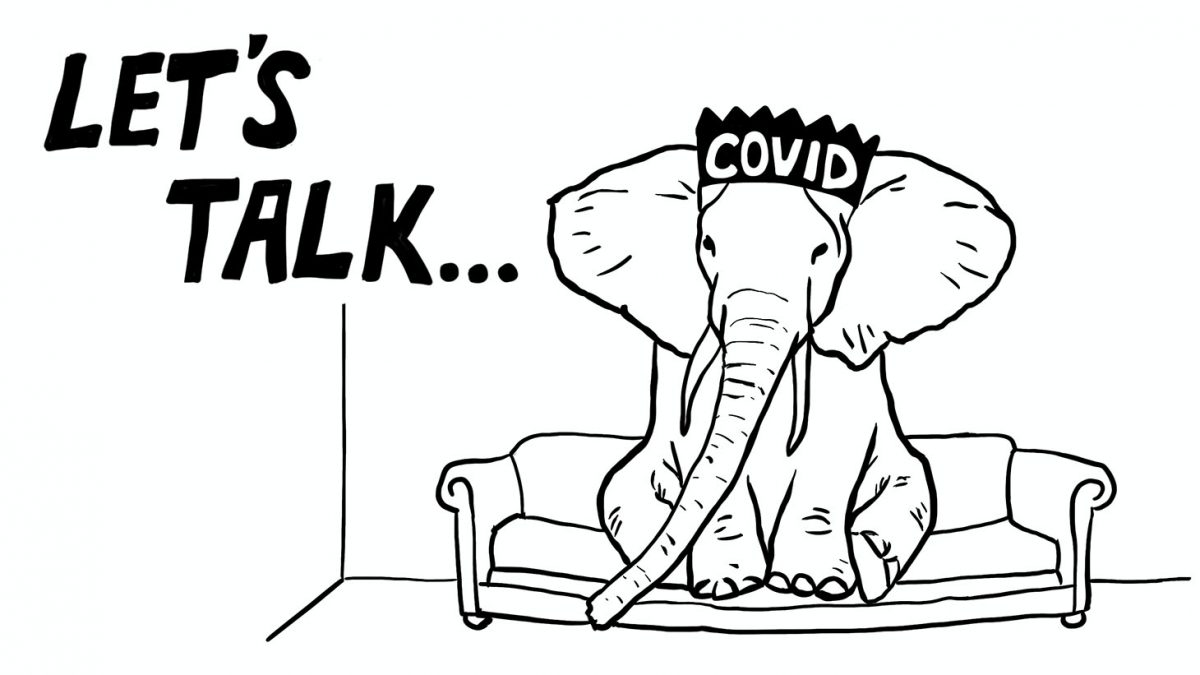
Covid Elephant in the Room

There’s no denying the proverbial elephant in the room these days: the Covid-19 pandemic, which has added an extra layer of complexity to all of our relationships.

Many of the principles we talk about in these blog articles are purposefully generalized. After all, each of us is an individual facing unique challenges so an emphasis on a response framework allows techniques to be applied skillfully and creatively in our diverse lives. Yet sometimes it’s worth exploring a more specific application of principles, as some experiences are encountered alongside a wider trend.

Back to the Covid elephant in front of us: from a faint and distant beginning, this novel coronavirus arrived firmly on all of our doorsteps sowing seeds of disruption.

Looking out through our peepholes, we answered our unexpected guest’s knock with cautious questions: What are you? How do you get around? Are you going to cause trouble? …And what should we do now that you’re here?

But on the other side of the door, there were no clear answers. At its beginning, none of us knew what the repercussions of this global pandemic would be.

And so we began to uncover answers together; through study, experimentation, experience, and debate. Ideas were put forth, ideas were challenged, and ideas were refined. As our understanding evolved, so too did the virus under our microscopes as variants complicated the situation.

Amidst all of this uncertainty, each of us had to determine our own "best way forward." But we don’t always agree on what’s best, and polarizing ideas seeded discord. The global became personal and divides opened up.

US and THEM flags on opposite sides of a valley

Most of us have stumbled upon these divides firsthand: either online with avatars, at work amongst colleagues, or at home across the table from those closest to us. Even with family, it has become all too common to find ourselves walking away from an interaction muttering, "I absolutely disagree and don’t know how to even talk with you anymore." At least, this is a familiar refrain that we’ve been hearing here at Mediation Services.

What can we do in these stalemates?


There is a saying in conflict management: if you’re having the same conversation three times, then you’re not talking about the right thing. This is something that comes up time and again around heated pandemic topics. And so it begs the question: how can we talk about the right thing?

When it comes to conversations about Covid, generally we can group the quarrelsome topics into two different buckets:

  1. Thoughts about the disease itself – What we think about the disease, the role of government, the severity of the pandemic, opinions on vaccines, the helpfulness of masks, etc.
  2. How to best live in the situation we find ourselves in – How we navigate being with other people, what we’re comfortable or not comfortable with, etc.

If two people are having a conversation about ideas from differing buckets, it rarely is a discussion that moves forward and very quickly tends towards frustration.

We need to pay very close attention to what we’re talking about. Are we talking about the disease and our understanding of it? Or are we talking about how we are living our life and how we can be together?

Go deeper online at your own pace

One mediation session at a time, we’ve been taking notes on the paths we find forward. They have formed the foundation for an online course we’ve developed around these timely troubles: Covid Conversations: A Roadmap to Existing Together with Opposing Views.

This online course isn’t about changing your mind, or someone else’s for that matter (though there’s the potential for some movement in this regard in the process). Instead, it is geared towards talking and living alongside one another; speaking your truth, listening deeply to other people, and being able to stay in relationship (whether you agree or disagree).

Relationships matter. We are hardwired for connection; we have friends, we have family, and we have those we work with and live alongside in community. These elements will always be with us. As we emerge from Covid, our relationships will be largely impacted by how we have interacted and behaved during the pandemic period.


Just like a new virus lingers in society, so too do any relationship walls that have been erected alongside it. As time goes by, perhaps we can begin to dismantle those bricks – one conversation at a time.

In that spirit, Covid Conversations is both timely and timeless – ready for you to tackle any walls that might have built up in the last couple of years, at your own pace. Because we’re not at an end; this moment is just the one after the last, and we can work with it.

If you’re interested in opening up some conversations – or, if you’re trying to find a better way to show up to the tough ones – we invite you to check it out.

Sometimes a conversation is worth revisiting.
Bridging Divides: Learning to speak someone else’s language.

Confusion Corner likening to different conflict styles

“They” say that the key to healthy relationships is communication, but what happens when there is a communication breakdown? Misunderstanding, perceived aggression, misinterpreted lack of care…these feelings of distance aren’t hard to imagine in such a situation. And they can stoke a defensive fire within us, often unwittingly turning what was a natural conflict into a competitive and high stakes situation. Maybe “they” were on to something.

Fiery emotions can erupt when we clash with others. And if we succumb to these defensive feelings, a chasm begins to open up between us. If we do not carefully consider our next steps, this divide can quickly grow.

What if we could prevent unnecessary division by communicating in a way that the other person is more receptive to?

Previously we explored the idea that each of us has a preferred way of dealing with conflict. The important takeaway is this: in conflict, people like to be approached in the way that they would normally approach others.

Sounds simple, right? Perhaps, but simple doesn’t always mean easy. We all have a different way of approaching conflict. When our way of dealing with things doesn’t match up with someone else’s, this is when we can end up in situations where we’re metaphorically (or literally) shouting – but not being heard.


It’s like speaking another language.

Imagine travelling to another country – say, to a distant conference that’s being held in Geneva, Switzerland. You leave Canada and its familiar ‘eh’s behind, spend a disconnected day in international airspace, and find yourself touching down in a place you’ve never been before. Everything is shiny, and novel, and…not English. The cacophony of voices that echo off the hard airport walls are foreign and unknowable. Your grade school language studies help you to identify the noise to your left as French. But to your right…incomprehensible.

Let’s be clear: you are still a super-talented-and-funny individual, but just not an expert in every language. This is human, and no amount of raising your voice or repeating yourself is going to span a language gap.

In this situation, there are really only two options to make yourself understood: you can either learn to speak their language, or they can learn to speak yours. It’s worth noting that only one of these options is in your control.

Hello in different languages (in a speech bubble)

How does this translate to conflict styles? Remember: people have different preferences in how they approach communication and we’re aiming to meet them where they’re at.

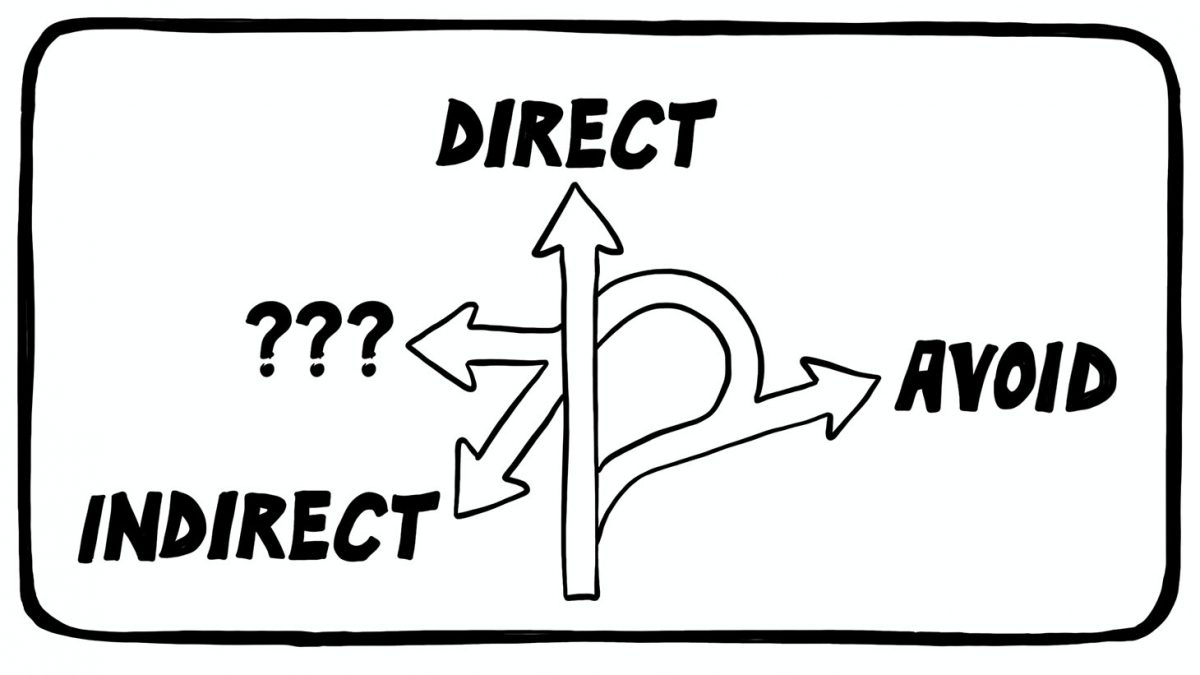
Assuming you both read the same dictionary, the basic conflict styles can be simplified to:

  1. Avoid: Try to find a way to coexist without confronting the conflict – The neighbour’s dog is barking at the moon…eh, I’ll just sleep with my noise cancelling headphones tonight.
  2. Indirect: Try to find a way to bring up the issue at hand in a roundabout way – I heard your dog barking last night…is everything okay?
  3. Direct: Deal promptly with the conflict at hand – Knock knock knock…quiet your dog down NOW (please).

Each of these different approaches are like different languages. Having proficiency in more than one is definitely going to be helpful. If you can learn to be adept in various styles of addressing conflict, you will be able to communicate clearly with a more diverse group of people. Because if we spend all our time in one of these styles…well, we are going to get into trouble at some point.

When communication breaks down, the first thing we can try is to give the other person the benefit of the doubt. Assume that it’s not personal and they’re dealing with things as best they know how. But if you are going to approach somebody to confront them, it’s wise to consider how you go about it so that you are heard.

Here are some helpful questions you might ask yourself:

  • Who is this person I’m in conflict with?
  • What is their style of dealing with it?
  • How might they appreciate my approach?

The way we see ourselves and the way we see others really impacts our interactions with people. If we can understand our own style and its strengths (while acknowledging the weaknesses), we can also appreciate the different approaches of others.

Start considering other people’s perspective of your actions in conflict. They don’t necessarily face life in the same way that you do. How would they react to direct confrontation? How would they hear you if you took on a softer approach? How can you put your energy in the right place to be heard and find resolution?

The old adage, "Treat others as you would like to be treated" doesn’t always work in conflict. You have to consider the other person’s conflict style and approach them in a way that works for both of you, so as to not be mistaken as aggressive, aloof, or something else that you are not intending to be.


There are several ways to work with conflict styles and we dive deeper into them with our online course Introduction to Conflict Resolution: Dealing with Difficult People. In it are tools to help you establish healthy relationship skills that will pay off in dividends over a lifetime, both for yourself and those that surround you.

And yet, sometimes despite your best efforts, you need to bring in a third-party mediator as a translator. Fill out an intake form for Mediation Services Winnipeg and we can facilitate a mediation session to help generate a clear understanding of everyone’s issues and concerns, working together towards resolution.

Things can get fiery when emotions get riled up. While it’s always wise to use carefully considered language to prevent conflict from escalating into a communication divide, sometimes it inevitably still happens. But, there is hope! We are adaptable, and divides can be bridged with a little bit of focused effort, openness, and creativity.

Lost in Translation: Different styles of dealing with conflict.

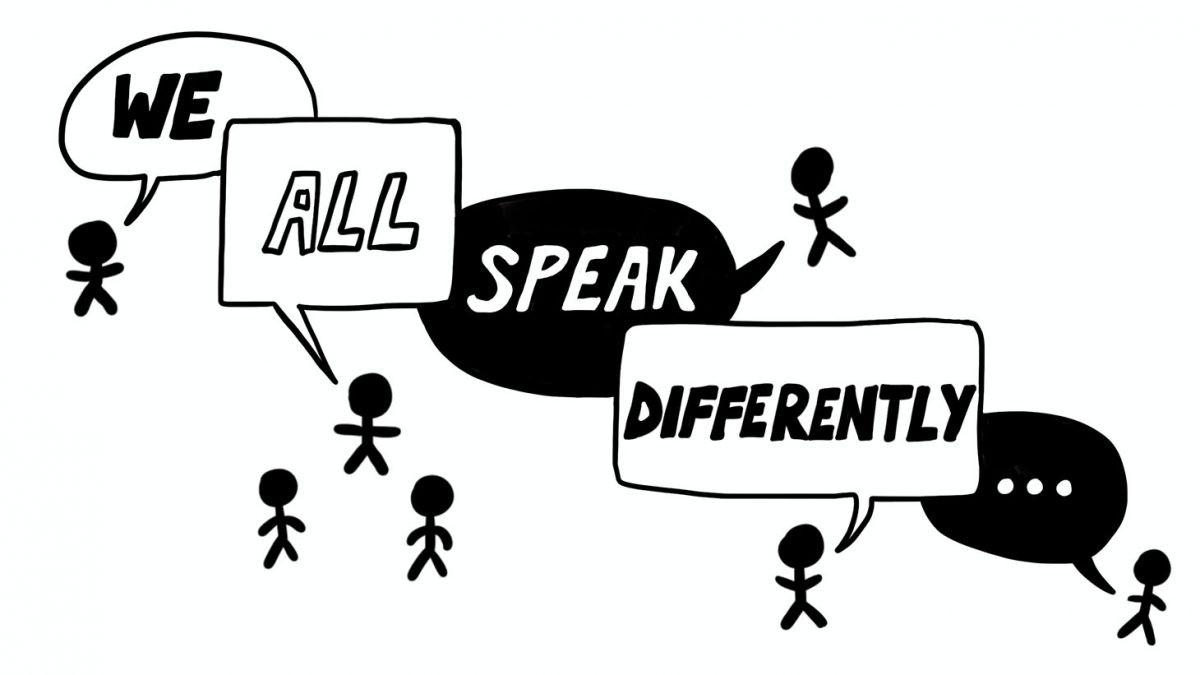
Illustration of people and speech bubbles talking to each other

Have you ever been speaking to someone about something that’s important to you, yet they don’t seem to be hearing the heart of what you are saying?

It’s not that the words rolling off your tongue are from an unfamiliar dictionary; it just seems that your words don’t land. Something is lost in translation.

Take for example the situation of a noisy neighbour. It’s getting late – the clock just ticked past eleven and you have to be up early in the morning. You’re already in your pyjamas, but your plan for a restful night has been interrupted by music and off-key singalongs that have only increased in volume over the past hour.

As you toss and turn in bed, you think to yourself, This is not cool. And so you’re forced into a situation with a few different options:

  1. Sigh and shrug it off – put in some earplugs, roll over, catch whatever sleep that you can and do your best to forget about it the next day.
  2. Push through the night – but politely bring it up the next time you and your neighbour are talking over the fence.
  3. Deal with it directly – put on your housecoat, step out into the party zone, and have a forthright conversation about it.

Obviously, there are other variables that might influence what you choose to do. Is this a frequent issue? What is your relationship like with your neighbour? Are you a light sleeper? Is it a jaunt across a snow-covered lawn at -30 degrees Celsius, or a shuffle down the apartment hall?

But beyond these circumstantial details, is you. Are you initially drawn to response number 1, 2, or 3? Each of us has a natural tendency to deal with conflict in a certain way. Which is yours?

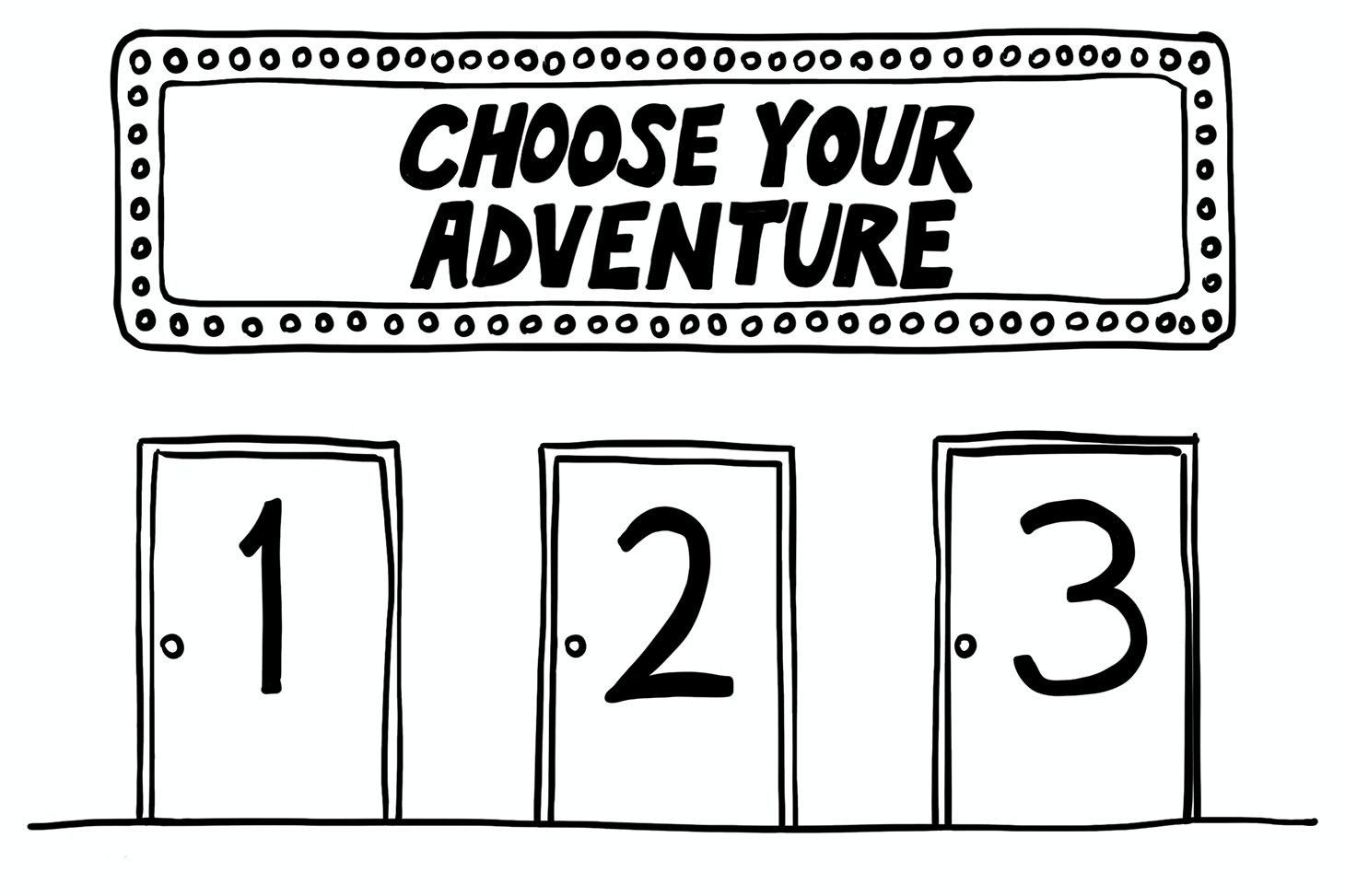
Image of three doors - numbered for different adventures

There is an impact behind our words that goes beyond vocabulary. What we say is informed by how we say it. And just like we learn how to walk by mimicking the gait of adults around us, we develop a personal way of dealing with conflict through a mysterious blend of nature and nurture; an individualized bit of character that influences how we interact with others.

Your neighbour is the same: they too have their own preferred way of communicating. The tricky thing is, it might be different than yours and that’s worth considering in the heat of things.

Research in conflict resolution shows that we tend to like being approached in a way that reflects how we would approach others. In order for our words to be received well enough at midnight (that’s right – another wide-eyed hour has already gone by as we’ve been contemplating this), we need to consider: what is the most effective way you can communicate your perspective and needs?

For instance: if your neighbour is typically direct, a casual mention of the noise last night might not communicate just how much it really bothered you. Or if your neighbour tends to be on the quieter side, blunt confrontation may be received as aggressive on your part.

If it really is resolution we’re after, it’s important to try to speak in a way that you are heard.


It takes a bit of work to get along with our neighbours – the same goes for family, colleagues, and…well, everyone. All we can control are our own actions, though even then it can be challenging because our initial reactions are often unconscious.

If we want to stay neighbourly, we need to gain a better grasp on understanding how we come across. Do our actions impact others? Absolutely. Can we learn to play our role in tricky situations better? Always. Will we make mistakes along the way? Almost certainly – but that’s okay too. The important thing is to take responsibility and try again. The goal isn’t perfection, but rather improvement.

The first step is to bring a bit more consciousness into our response to conflict, and in that space try to choose words and actions that won’t unnecessarily add fuel to the fire.

Next is to diffuse the tensions so that a conversation can actually happen, where both parties have an opportunity to speak and be heard.


In many of the conflicts that naturally arise in life you can find resolution on your own, but sometimes you get stuck at an impasse. It takes two to have a conversation, and there’s only so much you can do by yourself. In tricky situations, a third-party mediator can be especially helpful in creating a safe space for everyone involved.

Is this where you are at right now? If so, our qualified team is here as a resource. Head over to our mediation self referral page and fill out an intake form for neighbourhood/community conflict, family conflict, or workplace conflict. We can then facilitate a mediation session to help generate an understanding of everyone’s issues and concerns – and, importantly, to work towards an agreement.

There can be resolution on the far side of conflict, and we’re here to help you find it.

Good News: You can solve your own problems (and we can help).

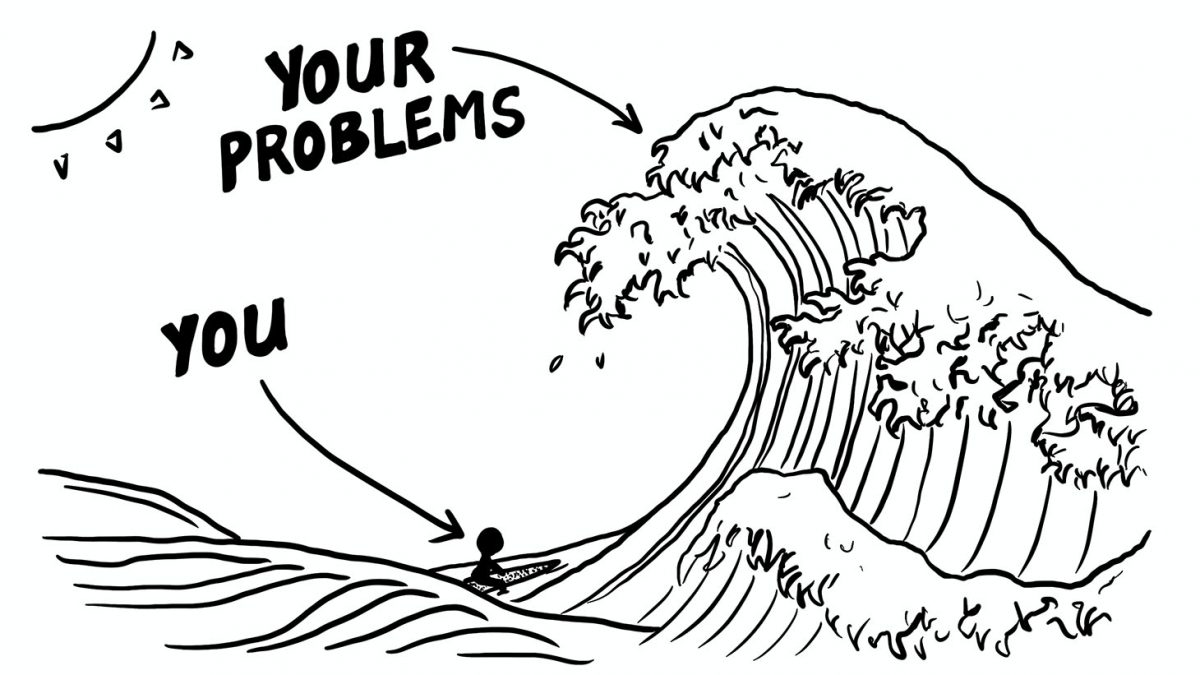
Your Problems Wave - Illustration

You are unique. Your ideas, your viewpoint, and your humour are entirely your own. Who knows you better than you? The joke’s on us if we don’t always pick up on your intended whimsy.

You know what else is unique? Your problems. And…who knows your problems better than you? As much as anyone else can try to peel back the layers around them, ultimately they are limited to looking in from the outside and are bound to miss some of the subtler things at play (perhaps similar to when they miss the punchline to your clever joke).

But problems sure aren’t funny when we’re going through them. That’s the bad news; the good news is that this intimacy with the issues at hand means you are also the one who is in the best position to solve them.


It’s hard to talk about what we offer here at Mediation Services without talking about why we offer it, because the why is what drives us to show up day after day. One of the foundational beliefs that drive the programming we develop is: You can solve your own problems.

Problems can take on a looming nature if we aren’t well equipped to deal with them; they can cast a shadow on us and our outlook. Yet, you are always capable of more than you were yesterday and with the right resources you can stand tall to face conflict when it rises up to greet you.

We believe in you, and that’s why we’re here.

One of the greatest gifts you can give anyone is empowerment to solve their own problems. In fact, you are uniquely capable of this because you’re the one who is fully in your situation. In the midst of conflict, you know best what is important to you.

Hello Problem Solver - Illustration

Though, it’s not all about you. To accept that we have power to act also means to accept responsibility for our actions, which can be rather humbling.

We are simultaneously sovereign individuals and inextricably interconnected to those around us; two facts that can be tough to grapple with concurrently when we’re stuck firmly in our own perspective. Sooner or later, friction naturally arises with others and there is a personal responsibility to that. We do, after all, play an active role in our relationships.

In other words: if it is harmony that we are pursuing, we can’t force our will upon others without consideration of them too. It requires a bit more softness and a little less judgement, on both sides of the tough conversations that need to be had.


It’s also important to note that we need to be careful to not accept responsibility for others. While we have a certain liability with regards to our own actions, this is not the case with others whom we cannot control. And it follows that trying to control the uncontrollable is a futile task that does not end anywhere useful.

But relationships can be messy, and the lines delineating appropriate responsibility can be difficult to spot when we’re stuck in the midst of it. This is where a mediator can be especially helpful; to give clarity to the conversation, avoid further escalation, and pursue resolution.

This can take place on many levels, from learning mediation basics online in our Introduction to Conflict Resolution: Dealing with Difficult People to pursuing restorative justice outside of the court system. We strongly believe that you have the power to solve your own problems and are here to empower you to do so no matter where you may be experiencing conflict in your life.

Taking responsibility is hard, but when we can own what we’ve done it follows that we can figure out how to be better in the future. In looking closely at what we might have otherwise swept under the rug, we have the opportunity to clean things up and move onwards; with a special sort of gratification that comes with figuring things out for ourselves.

Conflict is Natural: A core belief behind finding win-win resolutions.

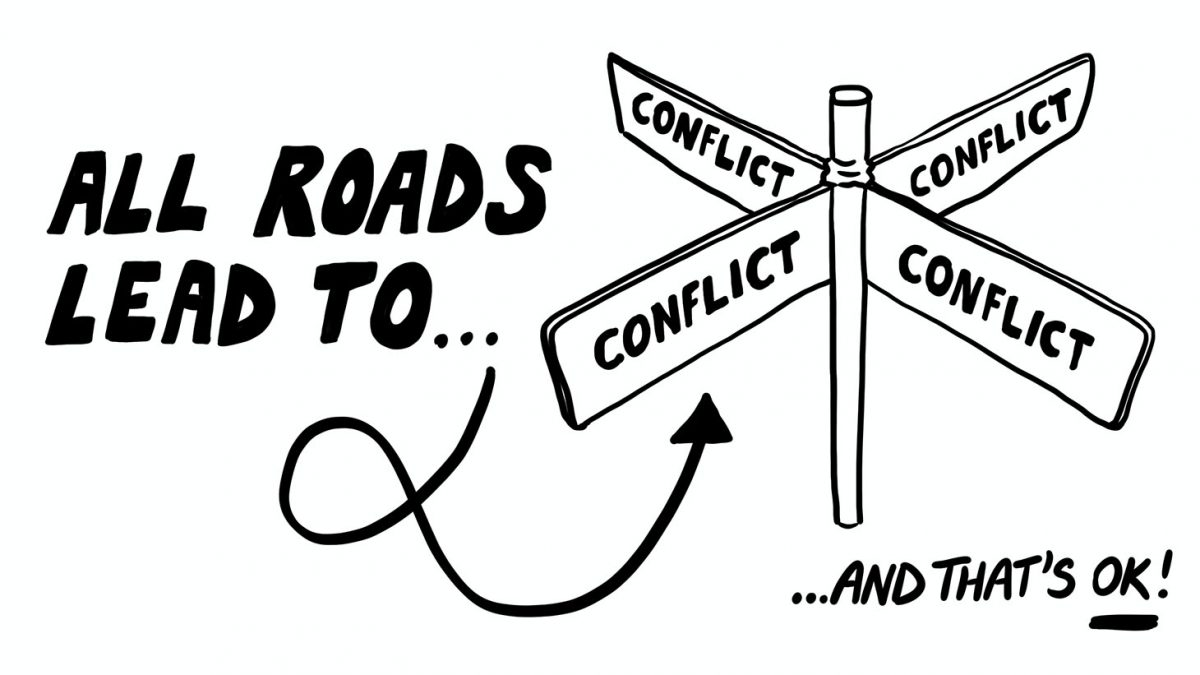
All roads lead to conflict - and that's ok

Here’s a strange thought: what if conflict is natural?

Wait wait wait – before you scoff at the idea and hastily close your browser, hear us out! This isn’t a nihilistic outlook that decries hope as futile and hardship as our inevitable reality. No no…rather, it is an invitation to accept that living in community inherently means that we will be interacting with people who are different than us – which is bound to be both a potent source for both joy and friction.

Conflict is undoubtedly uncomfortable, but what if we were to accept it as an unavoidable aspect of life? It seems to be an integral part of relationship; rearing its ugly head in even the most healthy ones. And so it begs the question: how can we better work within conflict rather than fight against it?


Let’s imagine for a moment that it’s an ordinary weekday in your life. You wake up in the morning feeling fresh and ready for the day. You hop in the shower and warm up the vocal cords with an off-key version of your favourite song – still fresh! You don a towel and brush your teeth – feeling minty and good! Retrieving your phone, you toggle it out of airplane mode and…bleep bleep bleep – notifications suddenly flood in, carrying forward the connections from yesterday. Some of the messages make you smile, while others force a reflexive cringe into your body and mind. You contemplate brushing your teeth again to re-find some freshness, but deep down you know that the only way forward is to face things.

Life doesn’t happen in a vacuum; in fact, it is as much defined by who we are as it is by our interactions with others. In this there’s a lot that is out of our control, which is a recipe for both beautiful serendipity and unexpected challenge – two sides of the same coin that cannot exist without the other.

Conflict is Natural - nature scene

Here at the Mediation Services offices in Winnipeg, we facilitate a safe space for conflict resolution from this foundational belief that conflict is natural.

This stance towards conflict can bring about positive changes in our relationships, despite the challenges that arise within them. But it requires us to work through the discomfort.

When face-to-face with a tough situation, try to remember: conflict is natural. Take a deep breath and slow down any reflexes that might kick in to fight or run away. Every situation is different, but it’s worth noting that conflict needn’t be considered a competition that has a single winner. With a little bit of work (and a little less judgement), the pursuit can be shifted to aim for a win-win resolution.

With practice, our response will take on a more relaxed shape. Leaning into difficult conversations, we can take an active role in pursuing beneficial outcomes.

Remember: there is hope in the fact that we can cultivate conscious choice in how we respond to things that happen to us.


There’s no getting around the fact that working with the conflict in your life takes daily effort though. The good news is, if we accept it as natural then we will see lots of opportunity to hone our skills with practice. When you show up and begin exploring what this looks like for you, we’re here with some tools to help you cultivate curiosity and connection that will help get you there.

Introduction to Conflict Resolution: Dealing with Difficult People is an online course we’ve developed for exploring the fundamentals of mediation in daily life. It is conveniently accessible from anywhere at anytime – there for you exactly when you might need it. You can sit down to learn at your own pace, and then integrate it with what you face when you step out into your life.

Or, browse the scheduled programming coming up and join us in-person or online (live via Zoom). We continue to fill the calendar with options that seek to address the current needs of the community, so do keep an eye on this blog and our newsletter for the latest and greatest.

Every relationship has the potential for highs and lows, and the only way to avoid the lows is to avoid relationship altogether – which, in so doing, also robs us of the highs. And even then, it’s impossible to live in a vacuum and so conflict is inevitable. It is our belief that it is better to embrace life with all of its peaks and valleys, while at the same time learning to better navigate them both.

Working with Conflict: The critical moment before we respond.

Press Pause

Have you ever felt like life happens to you rather than by you? Or rather, before you know it you find yourself in a conflict situation and wonder how you got there?

Things have an uncanny way of gaining momentum and us humans are optimized to deal with them quickly and efficiently, so much so that sometimes it can feel like we’re on autopilot. This is kind of amazing, that is until we realize we should have made a course correction a few steps back.

Changing our ingrained habits can be difficult – but it’s not impossible.


Think about the first time that you tried something new – like, say, the first time you swung your leg over a bicycle. You probably stepped on the pedals like you saw the older kids do, promptly falling over and scraping your knee on the pavement like the older kids did not. Okay, lesson learned – this isn’t as simple as others might have made it first look. After a bit of trial and error, you manage a wobbly but triumphant roll to the neighbour’s driveway. Flash forward a month, and you are flying down the street to the chagrin of cautious parents and drivers blurring by – wearing a helmet for safety, of course.

We learn from watching those around us and experimenting in our own way, but it doesn’t take long before this necessary effort falls into the background and our biology takes over. Our brains optimize as we go; smoothing out repetitive actions like balancing, peddling, and following traffic rules until riding a bike around the neighbourhood requires very little conscious thought. When we need to (such as riding home with a broken brake) we can consciously grab the handlebars, albeit with a bit more effort and a side of white-knuckled unsteadiness on the hills.

Automations are great for efficiency, but they also are prone to be applied bluntly and get us into troublesome situations. If we point ourselves down a hill and automatically reach for a brake that’s not working, we probably won’t end up in the best place possible.

No one wants to put themselves in the hospital, yet sometimes it happens.


Learning how to slow down

No, you are not reading a bike blog. This is just an example of how our brains work. The basic concept of learned behaviour provoking automatic reactions extends far beyond riding a bike and into how we treat ourselves, our relationships, and the world itself.

Conflict is no exception. We are prone to react quickly, in an automatic way that we learned over a whole life of trial and error. Without thinking we rush forward into the consequences of our response, sometimes good and other times…regrettable. Amidst all the variables at play, a generalized response is bound to occasionally put us in a messy place before we even realize it.

When facing conflict, it is helpful to slow down and take some time to think so that we can act more effectively. Sounds simple, right? Unfortunately, this is one of those things that is easier said than done – at least at first. Don’t despair: the neuroplasticity of our brains is never rigid and we can work with it to foster these elusive moments of pause and find conscious choice in tough situations.

Phone Chat Bubbles

The space between conflict’s occurrence and our response to it is pregnant with possibility. It is an opportune moment where we can insert a wedge in the self-perpetuating cycle of reaction to conflict, unlocking potential for a more positive outcome.

So let’s try it. Someone says something that rubs you the wrong way and you respond in kind with a snarky retort. And pause – wait…whoops, we missed it.

Attempting to hit pause when we’re primed to react with lightning-quick reflexes often results in us scrambling for the rewind button to try again. Unfortunately there’s no going back (pending the invention of time travel, of course), but at least we can always try again next time. The good news is that each time we do find a bit of space, that new neural response gets a little bit stronger and more within reach.

When triggered by conflict, try holding off on your snarky retort and instead first ask a question in an attempt to understand the other person’s perspective. If we take a moment to bring in a bit of open-minded curiosity to try and understand where our antagonist is coming from, we can actually end up having a better chance in communicating our own perspective.

There’s no point in sugarcoating it; changing ingrained habits is not easy, but the good news is that it gets easier. Each time you manage to find a moment of pause you begin building it as a positive new habit, which in turn begins to feel like a natural response. Eventually, it will be, but it takes effort to build the neural pathways to get there.


What next

At Mediation Services, we are here to help you better your relationship with conflict which in turn will benefit your relationships with others. A large part of where we focus our efforts is in the response, because this is where we can find lasting change in working with anger, hurt, and other tricky feelings. Ultimately, our goal is to help you find the tools that work for you; skills that can be taken home and applied towards conflict resolution in the ongoing challenges that life presents.

We have an online course that is immediately accessible and a great place to start with managing conflict in your life: Introduction to Conflict Resolution: Dealing with Difficult People

Beyond that, we have a myriad of in-person and online live Zoom programming for a more personalized experience. We offer training to deal with conflict in your life, as well as taking care of others who come to you with conflicts in theirs.

Take a look at the scheduled programming coming up, and perhaps you will see an opportunity that fits your needs.

Where we come from and what we face varies a lot. Here at Mediation Services we aim to help you find pause when you need it so that you can consciously participate in choosing your best path forward.

If you have questions,
please don’t hesitate to call.

1-204-925-3410

Subscribe To Our Newsletter

For The Latest News & Updates